U.S. Education: Will This Work?

My last post – Fifty-Two Years – touched on the importance of primary and secondary school education for the future of the United States. Not just for the U.S., of course, but that’s the system with which I am most familiar. I’ve also touched on education in earlier posts, including A Simple Candidate for a Simple Electorate. There I noted that the American Association of Mangers estimates 2 million of the anticipated 3.5 million high tech manufacturing jobs to be created over the next decade will go unfilled due to low numbers of sufficiently educated high school graduates.

So how do we improve the U.S. education system so that a large percentage of graduates have the skills needed for long-term success? There is no shortage of opinions out there. Here are a few:
1. Equalize per student spending so every child has the same chance;
2. Make it more difficult for poor teachers to remain in the classroom by curbing tenure and reducing the power of teacher unions;
3. Get corporate America to partner with the education system to ensure graduates have the skills needed to thrive in the current and future economy.

Let’s explore these.
1. For most states, money spent to educate our children comes from federal and state taxes (generally evenly divided per pupil), and local governments which distribute property tax revenues. This system means that schools surrounded by wealthier neighborhoods will have more resources than schools surrounded by poorer neighborhoods. Just like in the Deep South in the 1950s, such a system entrenches the status quo and ensures that the children of wealthier people have more advantages and opportunities to succeed.

Because those with money and power benefit from the current arrangement – or at least their children do – there is resistance to changing it. Consequently, school funding formulas will likely stay relatively unequal until those in power are convinced that the country’s future wellbeing is jeopardized by a system which provides a subpar education for a significant percentage of students.

2. Some states have taken steps to weaken unions, including teacher unions. There are twenty-five Right-to-Work states which means that an employee cannot be compelled to join a union. This weakens unions because they have fewer members and, as a result, less money to spend and less negotiation power with management. Michigan’s two teacher unions are discussing a merger because both have lost members since 2013 when Michigan became a Right-to-Work state.

3. Germany’s education system includes a good apprenticeship program which works in conjunction with large companies like Siemens, Deutsche Bank and Daimler. Nearly 60% of German students are enrolled in such programs in which the last 2-4 years of school are split between classroom instruction at a vocational school and on-the-job training at a company. In the U.S. only about 5% of workers are in an apprenticeship program and the vast majority of those are in the construction trades. The fields serviced by Germany’s apprenticeship programs are advanced manufacturing, IT, banking, hospitality and more.

A similar system seems like a good option for the U.S., but there are some concerns that will probably keep its impact small. In Germany, an apprenticeship program is considered a good, desirable career path, but in the U.S., it is often thought of as a place to put difficult students. And then there’s the cost. Companies spend $25-80,000 per apprentice in Germany, but at the Siemens USA plant in Charlotte, NC, the company spends around $170,000 per apprentice. A big chunk of the difference is that the government pays the post-secondary school tuition in Germany, but the company is responsible for the tuition bill in the U.S.

That is a large price tag for developing a worker, especially since a company can just hire a skilled worker away from another company for considerably less than what it takes to grow your own, so to speak. Apprenticeships may grow in the U.S., but not likely at a rate that will make a significant impact for at least a generation.

Will This Work?
I have a common sense suggestion. Let’s provide year round education for the lowest performing schools (bottom 5-10% to start), including reduced or free breakfasts and lunches, if applicable. Possibly, we should also shift the school day to later start and end times.

Here’s My Reasoning
1. In most states, the poorest performing schools are found in impoverished, high crime neighborhoods in medium to large cities. For many struggling students in these schools, poverty is the main factor that keeps them from succeeding academically. Poverty generally means hunger, and it’s difficult to perform any task well when you’re starving. Poverty also manifests in gang activity because the promise of riches through illegal activity is a real draw to those who always have to fight for basic needs. That gang activity leads to violence and the crime affects schoolchildren both within and outside of the gangs.

If these students for which educational success is a low priority when compared to basic survival find themselves with year round schooling and nutrition, school may become the highest priority. The number of days without food is reduced and school may be seen as a valuable asset not to be squandered.

The time out of school – evenings, weekends and several 2-3 week breaks throughout the year – would be the risky times. Can churches or other nonprofits feed them when they’re not in school? Will the gangs still have such a prominent role in the students’ lives if there is no long summer break and when they are in school later each day? I honestly don’t know the answers, but some students will likely make school a priority.

2. There are many proponents for year round schooling. One important factor is that knowledge is lost during the long summer break, even in very good, committed students. Teachers assign required summer reading lists now – much of it ignored most or all of the summer – but there’s not much that can be assigned in May or June that retains knowledge in science and math during the long break. Year round education means the breaks are shorter (2-3 weeks between quarters or quintiles) and much less material would have to be taught a second or third time.

3. Because not every teacher within a school district will be required for the full-year schools, superintendents will have the ability to choose the staff best suited for the positions. The teachers would have to be willing to give up the long summer break, but would have the opportunity to travel during off-peak times and pay off-peak rates so their money goes further. We can probably assume that this works best for young, energetic teachers.

4. So what happens with the students and teachers in the next group up – bottom 20%, but above bottom 10%? I suggest that there will be upward pressure. Both students and teachers may put in a little more effort so they are don’t end up in the bottom 10% at the next evaluation. And that puts upward pressure on the next group up, and so on. By going to year round education for a small percentage of students, we may create a domino effect that improves the success of nearly all students.

5. Why bottom 10%? Tourism. We Americans like our summer vacations, and we don’t want them ruined by homework or other interferences like classes. Here in Western Michigan this time of year, the sun is out from around 5:20 am to 10:50 pm (civil twilight). Homework and schooling would cut into the summer days and nights and our kids wont be able to join us at the fire pit.

But if we’re talking about the bottom 10%, there would be very little impact on tourism. Most of those students are from poorer communities and aren’t spending a week at a beach house or roasting marshmallows over an open fire. The tourism industry’s only potential concern would be the slippery slope argument. If this program is successful, you could have year round education for all and there goes the tourism business. In the long term, however, a high skilled workforce means a better economy and more money to be spent on vacations.

What the Teachers Say
I’m a camp counselor this week and several of my fellow counsellors are teachers who have much more experience with the U.S. school system than I. Here are some comments.
1. We don’t want to institutionalize students, i.e., segregate them from their families;
2. A year round program for only some students is a “separate but equal” system;
3. With respect to the students’ parents or guardians who suffer from addiction, their development stopped at the age at which they became addicted (if addicted at 15 years old, a person acts like a 15-year old at any later age);
4. The teachers do the best they can within the current system, but it could be improved.

Please let me know what you think, especially if you’re a teacher or administrator. I’ll compile the comments in a future post. Thanks.

Posted in Economics, Education, U.S. Politics, Uncategorized | Leave a comment

Fifty-Two Years

I’m a numbers guy so it struck me as newsworthy when two events this week were reported using the same number – 52 years. One was a happy story, at least for fans of the Cleveland Cavaliers. For the first time in fifty-two years, a professional sports team from Cleveland won a major sports championship. The other. Fifty-two years after the disappearance of James Chaney, Andrew Goodman and Michael Schwerner, officials in Mississippi are closing (again) the investigation into the civil rights workers’ murders – the event that inspired the movie Mississippi Burning.

The racial implications of these two events are important. In African-American communities, basketball is considered a way out of poverty, and there are many examples in the NBA and NCAA of its power to make that dream a reality. I remember Carmelo Anthony and Jim Boeheim announcing together Anthony’s decision to leave Syracuse after one year to enter the NBA draft. Boeheim expressed his support because it would give Anthony the opportunity to help his mother out of the rough, drug-infested neighborhood in Baltimore where she raised her four children as a single parent following the death of Anthony’s father when Carmelo was two years old.

And then there’s Mississippi in 1964. Chaney, Goodman and Schwerner were killed because they were working to equalize the rights of whites and blacks through education, boycotts and voter registration initiatives. It was part of what is now known as Freedom Summer which brought activists from around the country to the Deep South. For many people in those southern states, this was unwelcome interference by people who did not share their values. They felt they were being treated disrespectfully and their whole lifestyle was being ridiculed by the press and these meddlers. To them, the Deep South was being portrayed as backwards and stupid.

This view was not that far off. The lifestyle that the people in those southern states were trying to preserve was one of racism, oppression and unequal rights. People in most of the country felt that it was time for a change, and that the people who did not want change were racists. The press – recognizing a shift in popular opinion – were eager to highlight abuse by local politicians, law enforcement officials and the Ku Klux Klan (KKK). Many of these officials looked like buffoons to the rest of the country.

Alabama Governor George Wallace’s inaugural address in 1963 sums up these feelings in its most famous line. “In the name of the greatest people that have ever trod this earth, I draw the line in the dust and toss the gauntlet before the feet of tyranny . . . and I say . . . segregation today . . . segregation tomorrow . . . segregation forever.” And who are “the greatest people that have ever trod this earth?” That is answered earlier in the paragraph when Wallace identifies the Alabama capital as the “very Heart of the Great Anglo-Saxon Southland.”

As evident from this speech, the people of the Deep South felt the controls imposed by the federal government were an exercise of tyranny, and to most people in the rest of the country, Wallace sounded a bit crazy.

But another line from that speech is important. The previous paragraph, in its entirety, reads, “I want to assure every child that this State government is not afraid to invest in their future through education, so that they will not be handicapped on every threshold of their lives.”

Even though George Wallace had no intention of truly equalizing education for all races, he recognized the importance of education for future success. The wording is quite striking – “so that they will not be handicapped on every threshold of their lives.”

And that is an important connection between these two “fifty-two years” events. Education.

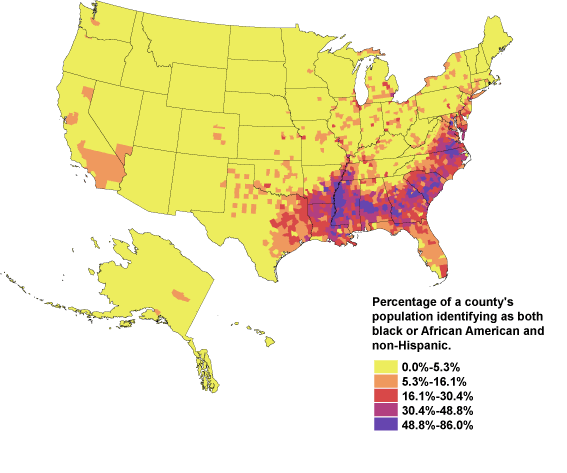
In 2014, 12% of white children under 18 years old lived in poverty while 38% of black children did. That is quite a disparity, and it’s easy to see how this situation developed when we look at where in the United States African-Americans make up the highest percentage of the population. Look at the following map from censusscope.org.

image

The highest concentration of people who identify themselves and black or African-American, but not Hispanic are found in southern states.

It was in several of those states that barriers to African-American advancement were most prevalent and blatantly racist. Obstacles to equal education, voter rights, equatable treatment in public life, and fair labor laws were fierce and designed to keep black people from rising above a subservient position in the social hierarchy. Elected officials, law enforcement officers and the KKK used any means necessary – including terrorism, torture and murder – to enforce these barriers.

Keeping a black person from getting a good job, voting or drinking from the same water fountain as a white person keeps the status quo for a while. Making sure black children receive a poor education when compared to white children, on the other hand, ensures a multi-generational advantage for white people. It is little wonder why the federal government in the 1950’s and 1960’s considered public school education in the Deep South to be so important an issue that they were willing to sent in the military to enforce change.

So what do we do now with 38% poverty for black children versus 12% for white children?

One of the factors that determines success in school and following graduation is parent/guardian involvement and expectation. When the parent or guardian lives in poverty, they are less likely (or have less opportunity) to be involved in the schoolchild’s education. Sometimes this is a result of the need to work multiple part-time jobs to make ends meet, and sometimes it is due to drug or alcohol addition, or other factors which prevent involvement. Regardless, the schoolchild who lives in poverty is going to have a harder path to a good education. Also, because hunger is often a way of life for children in poverty, success in school can take a backseat to basic survival needs such as finding enough to eat. And let’s not forget crime. Poorer neighborhoods have more gang violence and other crime that the schoolchildren must navigate in their daily lives.

In the United States, school funding is generally effected by the wealth of the surrounding neighborhoods. Children from wealthier neighborhoods almost always have better and newer schools to attend, and more money spent per pupil, than for children from poorer neighborhoods.

Is it any wonder that poor children often struggle in school? And that struggle will affect African-American students more than three times as often as white students because a much higher percentage of black students live in poverty.

So what can we do? More on that next time, but one thing is for certain. There are not enough college and professional sports positions to pull more than a tiny fraction of impoverished children out of poverty. We need a better plan.

Posted in Education, Musings, Uncategorized | Leave a comment

War is Hell (Poland Trip – Part V – More History)

I’ve been rather busy lately, but my brother-in-law sent some additional information which I have copied and pasted here (Thanks, David). I think he got most of this information from his own research and a visit with his father to his uncle’s house so the two brothers could jog each other’s memory.

“Stalin released the Polish prisoners as a part of an agreement with the Allies. The initial process was to establish a Polish fighting force that would fight along side the Russian forces in attempting to defeat the Nazi forces. Stalin, of course, became paranoid that the Poles would turn on the Russians, and although he kept his side of the bargain in letting them go, he did not want them to fight on the Russian front. There was also the issue of lack of supplies and food for the existing Russian forces which contributed to his subsequent decision to have most of the almost 80,000 strong Polish army moved to Iran and eventually under British control.

The Poles, unofficially known as Anders Army after General Wladyslaw Anders who was appointed commander of the Polish forces by General Sikorski, were known as fierce fighters and were instrumental in helping the allies take stubborn axis strongholds in the Italian campaigns. Anders had been a prisoner in Lubyanka before being released and taking command and did not have a lot of love for the Russians. Interesting side note, one of the Polish fighters released from the camps was future Israeli prime minister Menachem Begin.

Once the polish family members began to be released, their first real aid station was in Uzbekistan (pretty sure this is where Dad and family started this part of their journey), somewhere near Tashkent. This is where they were de-liced and fed for the first time. Dad recounted how the first arrivals at the aid camp were so malnourished and the aid workers so shocked that they gave them too rich food, and the vast majority of them died from dysentery. When Dad got there they were fed clear broth with a tiny shred of meat, and would slowly be re-introduced to food. Dad’s sister was so infested with lice that when they deloused her, her entire scalp came off along with her hair. They thought she was going to die, and if she lived that she would be bald (she lived and grew her hair back). From Tashkent, they started their journey through Persia, Afghanistan, India and eventually Africa.”

A Little Modern History
I knew that Polish visitors to the U.S. must obtain visas to enter the country, but that is not the case for visits to Canada. Consequently, we plan to join my wife’s cousin & her family in Toronto or Niagara Falls when they come for a visit sometime in the future.

A visa to the U.S. costs time and money. A Polish citizen applying for a visa (including children) must pay $160 and submit to an interview with a U.S. consular officer be considered for a visa. There is currently a nine day wait for an tourist visa interview in Warsaw. Processing may take as little as one day, or as much as sixty days.

Most countries in the European Union are members of the Visa Waiver Program (VWP) which means that their citizens do not need a visa to visit the United States. Member countries include many of Poland’s neighbors, but not Poland. Poles consider this unfair. They are staunch allies of the United States and there is long history of cooperation between the two countries. In fact, there are about 10 million Polish-Americans in the U.S.

And oddly enough, that is part of the reason that Poland is not eligible for the VWP. By U.S. law, in order to be considered eligible for the VWP, a country must have a visa rejection rate of less than 3%. That is the rate at which U.S. consular officers reject visa applications for a given country. Poland has a relatively high rejection rate because a significant percentage of those who enter the U.S. overstay their visas, in part because of the support offered within the large Polish-American community. Approximately 40% of the illegal immigrants in the U.S. are people who have overstayed their visas, and Poland is in the Top 20 countries of origin for illegal immigrants.

But there’s hope. Poland’s visa rejection rate has dropped from 13.5% in 2009 to 6.4% in 2014. The Polish economy is growing steadily and Warsaw is a modern city with an impressive business center. Those factors will reduce the desire to emigrate to the U.S. and the visa rejection rate will drop further. Within five years, the rate will probably be around 3% and Poland may very well become a VWP country.

Side note: My father-in-law’s doctor said that Jewish Polish-Americans lobby the U.S. Government to keep the visa requirement in place so as to encourage the Polish government to pay reparations to Polish Jews who lost property during the communist regime. The Polish government’s position is that they cannot compensate any Pole – Jewish or otherwise – for the actions of that previous regime. I could not find evidence of this during my research.

We so enjoyed our time in Warsaw and consider it a good place for ex-patriots to retire. The cost of living is low by U.S. standards and Poland’s EU membership makes it a good location from which to visit the many wonderful places in Europe. Language, on the other hand, could be a problem for me.

The Polish alphabet has 23 consonants and 9 vowels and many don’t follow the same rules that we English speakers are used to. I can probably learn that “dz” makes a j-sound and that “ł” is a w-sound, but “prz” is going to take a bit longer. Apparently, you’re supposed to pronounce each letter’s sound very quickly, but to my ears it sounds like “che.” That’s not even close. No wonder my wife laughed at me every time I attempted to speak Polish on our trip. Come to think of it, she wasn’t the only one who laughed or looked confused at those times.

Posted in Poland, Uncategorized | 1 Comment

Stalin Probably Saved My Father-In-Law’s Life (Poland Trip – Part IV – More Impressions)

This realization from my Poland trip came as a bit of a surprise. I had all the information before my travels – my father-in-law’s recollections & my knowledge of Polish history from September 1939 to June 1941 – but it wasn’t until I visited Poland that all the pieces fell into place.

Background
The nonaggression pack between Nazi Germany and the Soviet Union which was signed on August 23, 1939 contained secret protocols in which the two nations divided Eastern Europe into German and Soviet spheres of influence. Per these protocols, Poland was to be divided roughly in half. Germany invaded Poland from the west nine days later and the Soviet Red Army invaded from the east sixteen days after that.

Poland’s current eastern border is fairly close to the line of division agreed to by Stalin and Hitler for the 1939 pact, so a substantial portion of pre-war Polish territory is now part of Ukraine, Belarus and Lithuania. Some German and Prussian lands were annexed by Poland in 1945 which means that the country had shifted to the west following War World II.

The Aftermath of Stalin’s Invasion
The Eastern Polish territories taken over by the Red Army were scrubbed of Polish identity. There is a long history of such actions. When the Assyrians captured the Northern Kingdom of Israel around 740 BCE, they instituted forced migrations of the Jewish inhabitants to other regions of the Assyrian empire, and moved non-Jews into the capital city of Samaria. The Jewish identity was lost in the conquered kingdom due to intermarrying and the inability to worship freely or form Jewish communities. The Lost Tribes of Israel are precisely these tribes from the northern kingdom who were unable to retain their identity.

Stalin wanted to do the same with Polish identity. He removed everyone whom he considered a threat along with their families, and sent them to Siberia and other regions from which return is difficult. Nearly 1.7 to 2 million Poles were sent to the gulags and slave labor camps in Siberia, Kazakhstan, and Eastern Asia. Supporters of Stalin and the military moved into the conquered regions, and any Poles who were not considered enough of a threat to move were forced to become good soviets and learn Russian.

My Father-In-Law’s Experience
His father was an officer in the Polish army, and consequently a threat. In the middle of the night within weeks of the invasion, Red Army soldiers came to the house and gave them only minutes to gather up whatever belongings they wished to take with them. They were going on a journey, but they were not given the destination.

They were taken by truck to the train station and loaded into train cars designed for moving cargo or livestock, not people. Days later, they arrived in Siberia and his father was imprisoned in one of Stalin’s gulags. The rest of the family – wife, two sons and three daughters – were sent to a nearby work camp where the first order of business was to cut down and process trees into lumber to build the shelter needed for the brutal winter to come. It was already quite cold in October.

My father-in-law’s father died in the gulag and his young sister died in the labor camp. The food supply was insufficient to sustain those imprisoned. All lost weight; many died of hypothermia, malnutrition, typhoid and malaria. My father-in-law tells how he and other teens were beaten by the Red Army soldiers for stealing a little kerosene. It wasn’t needed for warmth, but a more urgent concern. They rubbed it into their hair, then on their faces, necks, arms and chests. They kept going – torso, crotch, upper legs, knees. Then they would visit with the Red Army’s ducks and geese. They would eat the lice off the boys lower legs and feet now that the rest of their bodies were uninhabitable because of the kerosene. This was life in the slave labor camps.

How Stalin Saved My Father-In-Law’s Life (Maybe)
Once Hitler had subdued Western Europe and built strong defenses against an invasion from the U.K., he turned his attention to the east. Breaking the nonaggression pact in spectacular fashion, Hitler launched the invasion of the Soviet Union through eastern Poland with Operation Barbarossa on June 22, 1941.

For the first couple months, the invasion was a great military success for Germany, but not the political success Hitler had anticipated. Within a month, the Germans had advanced more than 400 miles along a 1,800 mile front and had captured hundreds of thousands of Red Army troops, and important fuel and food producing regions. Hitler had expected that the Russian people would rise up and overthrow the Soviet government as a result of these embarrassing defeats, but the German army’s brutality worked against that outcome. Russians felt that an overthrow of their government would put them completely at the mercy of the Germans who seemed to have no regard for the lives of the Russian people.

Germany’s brutality was a directive by Hitler himself. In a March 30, 1941, secret meeting, Hitler warned his generals that the invasion of the Soviet Union would follow different rules – it would be a fight to the death between Germany and “Judeo-Bolshevism.”

Hitler: “The war against Russia will be such that it cannot be conducted in a knightly fashion. This struggle is one of ideologies and racial differences and will have to be conducted with unprecedented, unmerciful, and unrelenting harshness. All officers will have to rid themselves of obsolete ideologies. I know that the necessity for such means of waging war is beyond the comprehension of you generals but . . . I insist absolutely that my orders be executed without contradiction.”

The German S.S. followed quickly behind the advancing army and orchestrated the killing of every communist official, Jew and other undesirable that could be identified.

It is likely that my father-in-law – the fourteen year old son of an Polish army officer – would not have survived this campaign. He is alive today because he was tucked away in Siberia under deplorable conditions, but not in the line of fire.

Out of Siberia
Following the German invasion of the Soviet Union, Stalin began to work with the allied powers, including the Polish government in exile in London, and granted amnesty to some Polish soldiers held in Siberia. Evacuations began in March 1942, and those who were considered able to help the war effort were allowed passage to British controlled Iran and Palestine for medical care and assignment.

My father-in-law eventually made this journey, but not in the earlier evacuations; he was not healthy enough. When he arrived in Palestine for rehabilitation, he was 6′ 2″ tall and weighed 80 pounds. The British gave every new arrival a health status classification and my father-in-law got the lowest rating of D. He regained his health, though, and still a teenager, was sent to North Africa to perform non-combat roles for British troops.

And that is his story. The war eventually ended and he rejoined the rest of the family in a refugee camp in France. They were offered passage to Australia, but his mother refused because she had a superstition that the country was full of Devils. We wonder now if she misunderstood someone talking about Tasmanian Devils.

The family eventually made it to Ontario, Canada, and my father-in-law settled in Western New York as a result of his first marriage. A few years after her death, he remarried a wonderful, smart and resourceful women visiting Buffalo from communist Poland on a tourist visa and the rest is history. He turns 90 in a few months and has a long, fascinating life from which to entertain the staff and fellow residents at the assisted living facility where he now lives.

All of this may have been made possible by Stalin’s brutal treatment of Polish people in the regions he conquered. Go figure!

Posted in Poland, Uncategorized | Leave a comment

Darkened Windows – A Short Story

Considering the stakes, it’s surprising that no one seemed to understand the implications of the legal campaign. The seeds were sown in the unexpectedly strong American response to the “Reclaim Our Glory” presidential slogan. The idea of turning back the clock a couple decades proved to be incredibly addictive to the American people. It started with bold claims that had no basis in fact, but once the voters showed their eagerness to believe, the promises became ever more exaggerated with no possibility of being realized. It didn’t matter. The voters took the bait – hook, line and sinker. The partners of Jerome, Jerome and Avery, P.C., decided to seize the opportunity. The country was due for a change.

The lawyers felt there was some fat to trim in the legal system – that confusion of legal precedents – and they could act as the butchers. The presidential campaign had turned the American voters into the carving tools, so all they needed were the customers. Much discussion and a fair amount of forty year old scotch figured into that strategy session, but in the end, the decision was made to dive into the deep end of the pool. They would not begin with a small, trial suit. They were going for the big prize. Jerome, Jerome and Avery would solicit the Conference of Catholic Bishops in the noble crusade to narrow the definition of church and religion. The eight men and one woman around the conference table were certain that they were doing the right thing for the country. Quite good for the law firm’s revenues, too, of course.

It began with John Oliver. His ridiculous stunt of creating a church for his HBO show – Our Lady of Perpetual Exemption, indeed – led to the formation of hundreds, perhaps thousands of new churches over the following two years. They were making a mockery of the institution of religion and some controls were needed. The Church of Tax-Free Lottery Winnings was a perfect example, and let’s not forget the Brotherhood of Property Tax Freedom. Under the country’s liberal church definition laws, these ridiculous entities were actually legal churches, but with a Supreme Court consisting of five Roman Catholics and three Jews, now seemed to be the time to narrow the definition. All they would need was a tie.

They would bring the federal lawsuit in tax-and-spend, Roman Catholic Massachusetts. These mock churches caused injury to the institution of Roman Catholicism by siphoning off its congregants and their financial support with unrealistic promises of lottery winnings and unethical tax-evasion schemes.

The appeals case would also be heard in Boston by the U.S. Court of Appeals for the First Circuit which handled all federal appeals in New England. This would turn out to be the true test. While Catholicism is by far the largest religious affiliation for New Englanders, the percent participating in any regular religious service had dropped significantly over the past few decades. Still, other than some vocal wackos in New Hampshire, the two churches being challenged had only light support in New England. And the rest of the region was rather sick of New Hampshire and their motto anyway.

Jerome, Jerome and Avery enlisted the services of a highly successful political action team headed by Stanley Łewanski, the staunch Catholic who made his fortune in smoked meats. On the coattails of the “Reclaim Our Glory” presidential campaign slogan, Łewanski and his team engineered the “Back to Basics” movement. With push-polls, advertisements paid for by unknown groups with patriotic names, and support from several celebrities, the Back to Basics movement garnered tremendous support among a wide spectrum of Americans.

For the middle class, Back to Basics meant a return to stable manufacturing jobs, good affordable healthcare and reasonable college tuition costs. For men, it meant an end to political correctness and not having to look over your shoulder because something you said or did would come back to haunt you. For many women, it meant that it would again be safe to send your kids outside to play without having to worry about every little thing. And for immigrants, it meant a time when they were accepted as an integral part of a strong country and its growing economy.

To almost everyone, it meant an end of those ridiculous mock churches which were just created to help the rich avoid paying their fair share. Never mind that lotteries and the Top 1% have very little overlap; Łewanski’s team knew how to cater a message.

Under Łewanski’s direction, campaigns were organized in which angry citizens threatened impeachment of judges and elected officials if the First Circuit decided that the Church of Tax-Free Lottery Winnings and the Brotherhood of Property Tax Freedom were legitimate religious entities. They didn’t have a chance; the unanimous decision affirmed the lower court’s ruling against religious entity status. The losers wanted to appeal to the U.S. Supreme Court and, perhaps solely for the entertainment value, the ACLU agreed to represent them. Because the Republican Senate had no intention of holding hearings on President Hilary Clinton’s Supreme Court nominee, a 4-4 tie was as good as a victory for the Conference of Catholic Bishops. Things looked promising.
The Supreme Court ruling is only a few days old now, and it took everyone by surprise, even the partners at Jerome, Jerome, and Avery. During oral arguments, the justices gave little indication of how they would vote, but in hindsight, the composition of the court was the biggest hint – five Roman Catholics and three Jews.

The ruling affirmed the lower court’s decision that the challenged churches did not meet the criteria to be considered legitimate religious entities. That was not a surprise. The court then went on to clarify that criteria. At a result, other religious organizations lost their protected status.

In the unanimous opinion authored by the Chief Justice, the constitution was being considered a dead document with respect to religious entity status. In other words, the issue was considered from the prospective of the founding fathers at the time the Constitution and Bill of Rights was written, and not based on modern day situations. Only Judaism, Islam, Buddhism, Hinduism and the Christian denominations that existed in 1789 are to be considered legitimate religious entities; latecomers are not.

Appalachian snake handlers and non-denominational mega churches are reclassified as community organizations, and they will have to show that a high percentage of their income is used to benefit those outside of the community in order to keep their tax-exempt status. Churches that use radio and television to solicit contributions or sell products are now considered businesses and business tax forms will have to be filed with the IRS and state and local taxing authorities, if applicable. The United Church of Christ, Jehovah’s Witnesses and the Church of Jesus Christ of Latter Day Saints don’t have a long enough pedigree to qualify as tax-exempt religious entities.

There was an uproar, of course, but the justices pointed out in a rare written statement that the delisted organizations – not “churches” – could still achieve tax-exempt status as long as a large portion of their income went to help those outside their own communities. The statement also alluded to the fact that Supreme Court justices are appointed for life, and aside from impeaching all of them at the same time – which would throw the country into chaos – there wasn’t much that could be done about it. The justices adjourned the session and left the capital.
And so here I am, siting in this beautifully ornate and high maintenance church building on Manhattan’s Madison Avenue. Our non-denominational, all-faiths congregation purchased the building from the Episcopal Diocese of New York for a single dollar in 2009. The steady decline in mainstream Christian denomination membership in the U.S., combined with the financial difficulties caused by the Great Recession, led to the diocese’s decision to close St. Albans and sell the building. Our members, on the other hand, were drawn primarily from the Top 1%. Some disgruntled ex-members have referred to us as a country club or fraternity, but we didn’t mind. All religions are brotherhoods really, and being labeled a country club helped our recruiting efforts among those with means. Times were good – at least until the Supreme Court weighed in a few days ago.

Uncharacteristically for a large governmental agency, the IRS put out a statement within a day. They were bound by the U.S. Tax Code as it now stood following the Supreme Court’s decision to gut the religious exemption sections. Unless a constitutional amendment is ratified which will expand the list, the only Christian denominations which qualify for tax-exempt status are Roman Catholic, Episcopal, Methodist, Presbyterian, Lutheran, Baptist and Unitarian. Having spun off from one of those denominations after 1789 does not count. Of course, Wiccan also predated the founding fathers, but as it’s not a Christian religion, it seems to be excluded from the acceptable list per the Supreme Court’s decision. There weren’t any Wiccan organizations receiving special tax treatment anyway.

The IRS Director warned that the language for a constitutional amendment to widen the tax exempt status of religious organizations would have to be carefully crafted. If too vague, the amendment may make a wide range of other organizations and businesses tax-exempt. Should that happen, the federal government tax revenues could be cut by as much as fifty percent. The same peril exists for any state or local entity hoping to exempt certain non-Supreme Court defined “churches” from tax and reporting obligations. New York City has already decided not to venture into this quagmire.
Our stained glass windows are truly masterpieces. In the morning sun, the blues are remarkably vibrant, the reds incredibly poignant. This church – both the building and the society – are a pathway to finding inner peace for me and so many others, but not today.

We need a new roof. We were only a couple weeks into our $6 million campaign, and had already received pledges totaling $2.7 million. Yesterday, the first few of our financially savvy Top 1%’ers withdrew their pledges because the donations would no longer be tax deductible. More are sure to follow suit. Our congregation will shrink and this beautiful building will fall into disrepair. We may be able to raise the needed funds by selling naming rights to our most generous donors – they do like to see their names on buildings – but that goes against the spirit of this all-faiths institution.

We appear to only have three options. We can shut down the church, sell the building, give the net proceeds to charity, and I can look for another job. I’m not certain for what other job I may be qualified, and besides, that sounds like defeat. Hell – it is defeat, but it’s still an option. We can also petition one of the approved churches for inclusion. Again, I would have to look for other employment.

We have one other valuable asset – the air space above our roof. We were offered $15 million last year if we signed over our rights and allowed a developer to build around and over us. We refused. We had plenty of money from a wealthy and generous membership, and such a building would change the character of our worship and community services. Maybe we should reconsider the offer. There are so many questions. Would that income now be taxable, and how long would it last anyway? How quickly will maintenance, property tax, legal and accountant fees drain our reserves? Are we even able to survive for more than a few years?

One potentially good thing: perhaps we wouldn’t have to replace the roof since it would no longer rain and snow on us. It seems like there is an uplifting message to be teased out of there somewhere.

It’s a little hard to do uplifting today. I can’t get my mind off the way the blues and reds will change when there is no longer direct sunlight striking those windows. I suppose a downbeat homily entitled “Darkened Windows” would hasten the exodus of our congregants. I’ll work on something a little more positive – tomorrow. Today, I just need to look at these windows.

image.jpeg

Posted in Religion, Short Stories, Uncategorized, Writing | Leave a comment

Stolen Jewish Property and Warsaw (Poland Trip – Part III – Impressions)

When my wife and I travel, I am acutely aware that I look like a tourist. My clothing and other aspects of my general appearance make that obvious, even before I attempt to speak phases in a language other than English. One factor which helps mitigate this effect is the purposefulness with which I walk. I walk through a city as if I belong – a vestige of my 4-1/2 years in Manhattan – and at times, someone will stop me to ask for directions in Polish or Italian.

Other than occasionally being asked for directions, we generally don’t experience cities as the locals do. We try, but when a substantial portion of a business’ income comes from tourism, authenticity seems to be lost. Those little Italian restaurants in which no one spoke English and the owners’ and diners’ kids played hide and seek in the dining room have been off the beaten path. Same for the Scottish pub in which we ate haggis and watched football. It was obvious that we were tourists, but what made these situations special was that our presence didn’t change the dynamics.

Once TripAdvisor or other travel guides recommend a local authentic experience within a city, change is inevitable. Unless you travel with a native, you can leave a city with a lot of photos of buildings and natural features, but without truly knowing the place. You only have a feel for how they cater to tourists. The commercial center of Sorrento Italy felt that way to me, but the hiking on the peninsula was fantastic, and that’s where we found the area’s flavor.

In Warsaw, we spent our evenings with my wife’s second cousin, Magda – a local – and went to traditional Polish restaurants and discussed topical issues. With Magda, we ate jellied meats (head cheese), steak tartar prepared right at the table and sang a traditional Polish birthday song for the man at the next table who was celebrating his 100th birthday.

We also learned about the World Jewish Restitution Organization (WJRO) and their work to identify seized pre-World War II Jewish property and help the owners’ descendants reclaim it. We have all heard about the Jewish treasures stolen by the Nazi’s – paintings, gold, jewels, antiques, etc. – but the stolen property also includes real estate.

Magda showed us beautiful ornate buildings that will have to be torn down because the current owners don’t want to make the huge investments required to save the buildings since there is a chance that a Jewish owner may come forward and claim the property. Throughout Warsaw, which had a significant pre-war Jewish population, there is a chance that a descendant may be found, documentation produced and restitution made. In the more densely populated portions of the city, however, the chances are considerably higher that a property may be reclaimed.

Nowhere was the Jewish population more tightly packed than in the Warsaw ghetto. At its peak, there were 400,000 Jews forced to live in about 1.3 square miles. All the property had Jewish owners and some may have had several owners over the course of the three years of the walled ghetto’s existence. Those being shipped out to the Treblinka extermination camp (at least 254,000 during the summer of 1942) may have sold their ghetto real estate holdings to fellow Jews staying behind. Whether this occurred or not, it would be risky for current owners of any Warsaw ghetto property – regardless of religious heritage – to invest heavily in its improvement.

We stayed at the Hilton Warsaw Hotel and Convention Centre. The front desk manager, Michał Molenda, made our stay especially memorable with his personal attention and by upgrading us to the suite on the top floor. We would certainly stay there again and recommend the hotel for anyone considering a trip to Warsaw. (http://www3.hilton.com/en/hotels/poland/hilton-warsaw-hotel-and-convention-centre-WAWHIHI/index.html)

That 26th floor vantage point gave us a unique prospective on the restitution situation in Warsaw, best presented in a few photos.

image  image

imageThe Hilton is less than ten years old and almost all around it, new buildings are going up in Warsaw’s modern business district. Almost.

imageAbove is the view of the Jewish ghetto. It was razed by the Germans following the ghetto uprising in 1943. Only a few buildings survived the systemic destruction by the Nazi’s, and in 2013, the owners of the three-story dilapidated Jewish Community Center wanted to tear it down and construct a modern building for a growing Polish Jewish population. There was an uproar and in this case, the owners are known and they are a Jewish community.
So, it’s complicated. But at the same time, Warsaw is a modern world city with much to offer. It’s hard to escape the troubling history of invasion, abuse and murder, but  with all that the city has endured, its inhabitants have an inner strength to work through some of the toughest problems.

It reminds me of that quote from George Santayana which, among other places, was posted at Auschwitz. “Those who do not remember the past are condemned to repeat it.” The people of Warsaw cannot escape their past. The scars are everywhere – memorials and damage from bullet holes alike. Museums and plaques are prevalent throughout the city in order to make forgetting the past impossible. In this way, the people of Warsaw hope that they are not condemned to repeat it.

Posted in Poland, Uncategorized | Leave a comment

The U.S. and Hitler (Poland Trip – Part II – Impression)

This is Part II of my Poland series based on our recent trip. Part I consisted of some early to mid-twentieth century history which helps as background for my impressions.

# 1: The United States played a larger role in Hitler’s rise to power than I had realized.

The United States and Hitler
I was taught in school that Hitler could have been stopped by a strong League of Nations, and the League lacked power because the United States refused membership. Congress decided to return the U.S. to an isolationist position following World War I.

It’s a reasonable assumption that Nazi Germany would not have been able to flaunt the terms of the Treaty of Versailles so completely if the League of Nations had included the U.S., but it’s not a certainty. It is well accepted, however, that Hitler rose to power on a wave of economic hardship and dissatisfaction with the established leadership.

The citizens of any region will be unhappy with their government if they believe they are being treated unfairly. They will support a leader who shares their frustrations publicly, especially if he or she promises to fix those problems. This may happen on the continental, national, state or local level, and rural and metropolitan areas will often have different feelings about certain situations because they have different cost-benefit considerations.

Today in the U.S., for example, there are ethanol fuel mandates. Farmers, seed companies, ethanol distillers, and politicians with rural districts like them because they produce demand, moderate pricing and generate votes. Car owners (lower gas mileage & higher corrosion) and people with high corn-based diets (Latin Americans and their descendants in the U.S.) don’t.

But what if it’s not just one region or one industry that believes it is being treated unjustly? What if it’s an entire nation? If almost all people in a country feel that they are victims – and the current leaders accept the status quo – a person who promises a way out of the untenable situation may win the right to lead. That’s true even if he or she is considered extreme by the “establishment” and the media.

Donald Trump’s popularity seems to fit this description, but he’s no Hitler and today’s U.S. is not 1930’s Germany. Trump’s proclaimed injustices are not universally accepted by those in the United States. These include illegal immigration, free trade agreements, a burdensome tax code, loss of manufacturing jobs, unreasonable treatment of Muslims (for Trump, this means that it’s unreasonable not to treat them as potentially dangerous because of their faith), etc. In post World War I Germany, on the other hand, the Treaty of Versailles was considered unjust by almost everyone, including those who insisted that Germany adhere to its dictates.

There were several portions of the treaty which offended Germans, but the huge financial payments to the winning powers (reparations) affected life most dramatically. The economy was struggling after the war. France, the United Kingdom and other countries put high tariffs on imports from Germany in order to protect domestic manufacturing jobs which they felt were threatened by low German prices. So Germany wasn’t able to use exports to improve their economy and raise the money for the required payments to France and the other injured parties.

The German government felt their only option was to print huge sums of paper money to pay for reparations and government services. As a result, the German currency lost value rapidly. Hyperinflation was so bad that the German people were forced to spend all their money as soon as it was received because the its buying power would be considerably less within hours.

And then there was the Great Depression. Like the recession of 2008-2009, it resulted from risky lending practices by banks, primarily those in the United States. When the shock of the October 1929 stock market crash hit, a large number of banks went out of business and the populace lost their own money. They couldn’t buy much of anything because they didn’t have currency; businesses went bankrupt, the depression deepened and unemployment soared. The Great Depression hit the U.S. very hard.

One of the first actions taken by the federal government at the start of the Depression was to recall the loans made to Germany. This was a devastating blow to a struggling German economy and led to even more pain and strife for its citizens. Unemployment skyrocketed and millions were out of work.

Adolf Hitler was a dynamic speaker who appealed to the disenfranchised, especially the unemployed, young people and members of the middle class who felt they were falling behind. (This makes me think of Donald Trump again.) He promised to return Germany to its prestigious position on the world stage and the Nazi party won the largest number of seats in the Reichstag (German parliament) in the November 1932 elections. The party went from 3% of the Reichstag in 1924 – five years into the hated Treaty of Versailles restrictions – to 33% in 1932 as a result of the hardship brought on by the Depression. Hitler became chancellor in January 1933.

The U.S. banking system is largely at fault for causing the Great Depression, although many wealthy Americans also behaved poorly. The federal government also recalled the loans it had made to Germany. These factors certainly contributed to the Nazi’s 1,000% increase in Reichstag seats from 1924 to 1932, and to Hitler’s rise to power.

While a more powerful League of Nations and/or a determined United States may have acted as a strong deterrent to Hitler’s actions once he became chancellor, the Great Depression mired the U.S. in its own problems and the rest of the world became less of a priority. Consequently, the Nazi party took universal actions which lessened the German people’s shame and humiliation as written into the Treaty of Versailles, and Hitler’s power and Germany’s military might grew in tandem.

World War II may not have happened if:
1. The Treaty of Versailles had not been so punitive for Germany,
2. France and the U.K. had not imposed high tariffs on imports from Germany,
3. The League of Nations had more power to stop German actions that were in opposition to the Treaty of Versailles,
4. U.S. banks and wealthy Americans had not caused the Great Depression,
5. The United States had not called in loans made to Germany at the beginning of the depression, or
6. The U.S. and/or the United Kingdom had taken an aggressive stance against German aggressions

Other nations share the blame for allowing Hitler to run amok, so to speak, but the U.S. had more to do with it than I had realized.

Posted in Economics, Poland, U.S. Politics, Uncategorized | 2 Comments

A Simple Candidate for a Simple Electorate

Donald Trump has a simple plan. He often says so, including this quote following his Indiana primary win.

“Our theme is very simple. Make America great again. We
will make America great again. We will start winning again.”

Many Americans like things to be simple, so they like Mr. Trump’s promises, especially when they are presented in simple language. According to Grammarly, Donald Trump’s sentences contain 3.3% complex language as determined by seven “clarity algorithms” including sentence length, passive voice and non-restrictive clauses. This is the lowest percentage within the 2016 presidential candidate field, all of whom fall well short of Ronald Reagan and Jimmy Carter at 17.2% & 17.3%, respectively.

So let’s look at one aspect of Mr. Trump’s simple plan. Would the candidate’s ideas on tax and trade policy bring manufacturing jobs back to the United States?

Donald Trump proposes pulling out of existing free trade agreements (FTAs) including that with Canada and Mexico (NAFTA), ending negotiations on new ones, and setting high tariffs on goods imported from countries unilaterally determined to use unfair labor practices. Regarding income taxes, Mr. Trump would like to cut taxes on businesses and upper income individuals to stimulate the economy.

This sounds great – it’s so simple. For many voters, Donald Trump should win the election because he assures us that we’ll all have good jobs, many in manufacturing, and things will go back to being the way they were in the good ole days. What could go wrong?

Well…what if the simple plan doesn’t work? There seem to be some flaws.

Protectionist Trade Practices
Would the establishment of protectionist trade policies help or harm the U.S. economy?

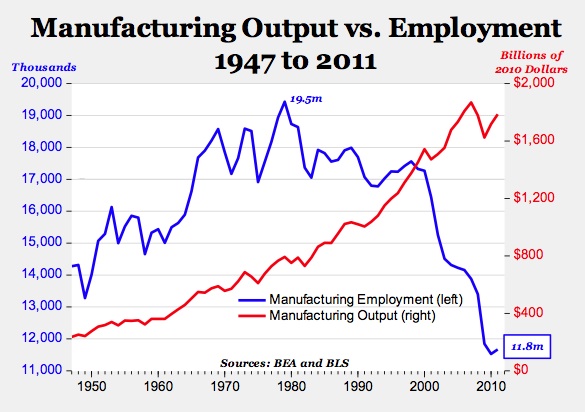
Manufacturing jobs peaked in 1979 at 19.5 million. There was a 14% decrease to 16.8 million in 1993, the year before NAFTA went into effect. Between 1993 and 2011, there has been a 30% reduction in manufacturing jobs to 11.8 million.

So is NAFTA to blame for the loss of these jobs? What about the other FTA’s the U.S. has enacted?

The United States has free trade agreements with twenty countries. The oldest agreement is with Israel which began in 1985 and has had a number of iterations. President Obama would like to execute the Trans-Pacific Partnership (TPP) which would modify the FTA with five countries and add six new ones. Both Mr. Trump and Ms. Clinton have come out against the TPP, so it’s future is uncertain.

How have manufacturing output and jobs changed over the era of the FTA? I have a rather dramatic graph for that.

image

For the first seven years under NAFTA, manufacturing jobs were created, not lost – a 3% increase to 17.3 million. What happened in 2001 which led to that steep loss of manufacturing jobs and who’s to blame?

Simple. Companies shipped manufacturing overseas once the federal government granted China permanent normal trade relation status in late 2000. And, sorry to tell you this, but many of us are also to blame because we didn’t stand up for the American worker with our investment capital.

This was the era of the Dot Com bubble. The stock market was soaring and a lot of us felt pretty good. Then our financial advisors suggested some high performing mutual fund with Asia in the title and we went for it.

With those mutual fund investments, we gave our permission. We gave permission that, as long as you promised us good returns, it was okay to ship jobs to China. Many of us didn’t know that’s what we were doing, and others decided that it was happening anyway, so it was best if their portfolios weren’t left behind, but companies took our permission and ran with it. They shuttered U.S. factories and built new ones in China and other Asian countries to take advantage of cheap labor costs and the consistent tariffs that normal trade relations promised.

At the same time other companies were building manufacturing plants in the U.S. and many were car companies. But the new plants were highly automated and could produce many more cars per employee than older automotive plants. Look again at that graph – there has been a steady increase in manufacturing output. The United States is still a manufacturing powerhouse. We’re just doing it with more robots and fewer people.

So back to Donald Trump. Would restrictive trade policies result in a return of the types of jobs that have been lost in droves since 2001?

No. Those jobs are gone and they’re not coming back. For clarity, those jobs are the ones where someone with or without a high school education could walk into a factory and do the same repetitive task for forty years. That job has been replaced by a robot, both in the U.S. and in other countries.

According to the National Association of Manufacturers, 80% of manufacturers report a moderate to serious shortage of qualified applicants for skilled and highly skilled production positions. The Association also estimates that 3.5 million manufacturing jobs will be created over the next decade under current trade rules and that as many as 2 million of those jobs will remain unfilled because too few high school graduates have the skills required for the work.

Highly protectionist trade policies could bring some manufacturing back to the United States, but it’s a huge gamble. First, without the skilled labor force to work in modern production facilities, we are not an attractive place to build a factory. Potentially, manufactures will promise to build in this country if they are allowed to import skilled workers under the H-1B visa program. This is the program used to import computer programmers because the U.S. education system doesn’t meet the tech industry’s needs, and we want to keep the companies in Silicon Valley. Should this happen with manufacturing, it would not be a proud moment for a Trump administration.

Second, what if the companies don’t bite? What if they decide that protectionist trade policies will be short-lived because American consumers would rebel at the higher prices? If we need a new toaster and there are none made domestically, we’ll still buy the toaster but complain about the price. I’m not sure a President Trump would want to claim credit for the high inflation rate that would result from large tariffs on products for which there isn’t a domestic alternative.

In short, manufacturing jobs of the 1940’s to 1990’s have been replaced by automation and Americans would become very upset with the higher prices from tariffs.

Income Tax Reform
I have written about this many times before, but tax cuts for the top 10% wage earners do not stimulate the economy.

In his economic working paper “Tax Cuts For Whom? Heterogeneous Effects Of Income Tax Changes On Growth And Employment,” Dr. Owen M. Zidar reports that tax cuts or increases for the top 10% earners in the U.S. have no impact on job growth over the following two years. Tax changes for the bottom 90%, however, have a substantial impact. For every 1% change in tax burden as measured by percent of a state’s gross domestic product (GDP), there is a 5% change in job creation over the following two years.

Donald Trump’s individual income tax plan would cut taxes on high income earners, but it does something else, too – it raises taxes on low wage earners. This isn’t obvious from Mr. Trump’s statements or campaign website, but when you realize that a substantial portion of taxpayers in the bottom 30% of income distribution have a negative tax rate under the present tax code (they receive more from refundable tax credits than they pay in), a 0% rate is a tax increase for low wage earners. According to Dr. Zidar’s research, this will slow the economy and reduce job growth.

Conceivably, business income tax cuts could stimulate the economy if well targeted. The problem I see here is that businesses will be reluctant to make large investments in an uncertain economic environment. Mr. Trump promises a 6% growth rate which would make his programs revenue neutral, but most economists disagree. They feel there would be a significant loss of federal income and much higher deficits. That is not an economic environment that fosters long term investment, and the proposed restrictive trade practices just add to the uncertainty.

As you may have guessed from these 1,500 words, I don’t accept simple solutions without justification. From my analysis, I don’t believe Mr. Trump’s simple tax and trade plan would bring back the jobs he claims. I contend that the people benefit the most from nice boring, steady growth – no bubbles and no bursts. Drastic actions – as proposed in Donald Trump’s simple plans – are not the best formula for this kind of growth.

Mr. Trump’s supporters want to believe he has a way back to the good old days, but that is based more on faith than reason. There is an almost religious fervor to this belief, and when it comes to religion, people are perfectly willing to abandon common sense and think they have all the answers. That is not a knock on all religion. It’s just that there are many which proclaim that they are right and everyone else is wrong in their beliefs. They can’t all be correct. Now that’s a simple statement I can support.

Posted in Economics, Religion, U.S. Politics, Uncategorized | Leave a comment

Legacy of Being Treated Poorly

I’ve done a fair amount of traveling over the past year. In fact, I’m writing this on a flight; I going to visit my son and do some work on the rental house in Sedona. Our children are dispersing and we use travel both to see them in their new habitats, and to entice them to join us someplace else for a family vacation.

We have had generally good experiences lately and I don’t dread air travel as I have in the past. That got me thinking about one bad experience and the lasting effects.

When my daughter was 11 months old, we made arrangements to spend a week in the U.S. Virgin Islands with my parents and used my accumulated miles to book two first class tickets on Continental Airlines. We took off from Buffalo, NY, circled for nearly an hour over western New Jersey, and were diverted to Syracuse, NY because of fog in Newark, NJ. These things happen, but Continental didn’t handle the situation well.

We stood in the first class line and were told to stand in the coach line because we had “non-revenue tickets.” Eventually we made it to the USVI, but they had cancelled the rest of our itinerary and we had a difficult time getting back. We had to pay for a hotel in a scary part of town because our original flight was sold out, and we were told repeatedly that we had non-revenue tickets. Continental blamed us for the problem because we had not checked that they hadn’t cancelled the return flight arrangements. For nearly a year someone from Continental attempted to close our complaint by offering a small voucher for future travel. Eventually I told them to stop calling – the calls simply reminded us of the ordeal.

We never flew Continental again, nor have we flown on United since they merged with Continental. In this case, I can really hold a grudge. It’s part of my Policy of Low Expectations philosophy. Back then, we would take one vacation a year and we expected it to be great. Continental ruined our vacation and more than twenty years later, I recall it vividly.

Until a couple years ago, we only used our accumulated miles for first class upgrades. We started to dip our toes back in the water with a trip to Italy on US Airways. It went well. Since then we have used reward tickets on American and Delta to go to London and again to Rome. Everything went smoothly with these airlines and their codeshare partners, KLM and British Airways. No “non-revenue ticket” inferiority treatment here.

And that got me thinking about the lasting effects from disrespectful treatment.

I have a good life. I’m too busy, but I often bring that on myself. My wife and I are doing well as measured by most metrics and we have many more opportunities than most people. Despite all this, I am still bothered by how poorly we were treated by Continental over two decades ago and it still affects my purchasing decisions. It’s not a huge injustice in the grand scheme of things. We had to pay for a night in a scary hotel near the airport and it cost us some pride, but they did eventually fly us both ways.

What if it’s a different type of disrespect? What if it’s racism, or sexism, or antisemitism, or homophobia? What if you’re treated as if you were less than human because of factors you cannot change – skin color, gender, your ancestors’ faith, sexual orientation? What lasting effect would that have on you?

We went on the three hour tour of Aushiwitz and Berkenau last week. I tell people that I’ve hit the age where I no longer have to watch depressing movies – I just want happy things from this point on in my life. I’m half joking, but there really is a part of me who wants to know what’s going on in the world – the good and the bad – but my entertainment should be entertaining.

The concentration/extermination camps tour didn’t feel that way. I was there to connect with a horrible part of human history and people don’t come away from such things without some kind of scar. The Jews of Europe were treated less than human and were even “processed” in the way you would handle livestock or vermin. The extermination camps were the most important part of the Nazi’s “final solution” to the “Jewish problem.” It is a deeply disturbing tour and one that as many people as possible should make.

Nazi Germany’s treatment of Jews and others they considered flawed is the extreme example of treating others poorly, but what about racism, sexism and homophobia.

The shootings of young black men, often by white police officers and citizens, has led to the Black Lives Matter movement. Many black people feel they are considered less than human and they have a point. The entire history of African and African-American residency in the Americas has been a progression from slavery to denial of rights to killings which felt like sport to reduced economic opportunities to crime-riddled neighborhoods to Stop and Frisk to a rash of shootings.

Sexism is a little harder for me to get a handle on. I am married to a very talented and successful women for whom I have always had the highest respect. I have also worked with other women and have never thought, “I’m better than they are because I have a Y chromosome,” or the appendage that results from it. It’s not disbelief that sexism occurs – it certainly does. It’s just that my mind doesn’t seem to work that way and I’m usually baffled by the thought process that must lead someone to judge a women as less valuable.

Homophobia is different. Notice how the other words are -ism’s. They are actions of denigration based on a clearly defined difference between the perpetrator and the victim. Homophobia is a fear. The perpetrator in this case doesn’t understand homosexuality, or fears that he/she may have similar “leanings,” or is feeding on lifelong religious teachings, or knows a gay man who is actually not like any of the stereotypes. No wonder there’s fear – it’s fear of the unknown or of not understanding.

What are the long term consequences?

One thing is proven time and again. Upward mobility in the African-American community is hard to achieve.

Women make about 70% as much as what men make. Some justification is provided that this is because they choose to leave the workforce for a period of time to raise families. Of course, that’s only a justification if you consider raising a family to be of little value.

For the LGBT community, discrimination and derogatory treatment lead to suicide at a considerably higher rate than in the general population. There is also an element of economic depression. It’s difficult to gain and hold a job if, in some states, you can be fired or kicked out of your apartment if your boss or landlord finds out you’re gay.

The United States would be a happier healthier country if we could treat everyone with respect. This presidential campaign does not fall into that category, I’m afraid. It seems as if you need to be mean to be noticed, and he who insults the best gets the most votes. I’m afraid of the lasting effect of this presidential campaign. It’s not a legacy we Americans should be proud of.

Posted in Musings, U.S. Politics, Uncategorized | 4 Comments

My Trip to Poland – Part I – History

My wife and I made our first trip to Poland a few weeks ago. It was a trip prompted by low airfare ($775 RT Chicago to Warsaw on Delta & Air France). We spent four nights in Warsaw, three nights in Kraków, and we met my wife’s cousins for the first time. We took the three hour Auschwitz-Birkenau Museum tour and visited the Warsaw Uprising museum For about four hours.

My wife is the daughter of polish immigrants. Her father grew up in a small town on the east side of pre-war Poland, but that area is now part of either Belarus or Ukraine – never got a clear answer on that. Her mother was from a small farming community near Bialystok which was in central Poland before the war and is now near the eastern border.

I plan to provide impressions, photos and connections in future posts, but I feel it is important to understand the history, so here goes.

A Polish history lesson (1939-1945)
Germany was defeated in World War I without losing any German territory to the allied forces. In fact, they had achieved substantial gains in Belgium, the Netherlands and France. The German people were largely caught off guard by the defeat. They knew of many dead and injured soldiers, and food was scarce, but neither the government nor the newspapers gave any indication that surrender was imminent.

The Treaty of Versailles required Germany to assume guilt for the war, pay reparations to the winners, accept military restrictions, and cede 25,000 square miles and the 7 million inhabitants who lived In those lands to other countries. Germany’s attempts to pay the reparations and revive the post-war economy led to excessive printing of money and hyperinflation. The Great Depression affected the United States most dramatically, but Germany was the country which suffered the second most. This situation led to the rise of Hitler and the Nazi Party.

In opposition to the terms of the Treaty of Versailles, Hitler’s Germany began to build up its military and demand annexation of certain lands in which a number of German speakers lived. France complained, but the other powers acquiesced because they felt the treaty had been too punitive on Germany. The United Kingdom believed that Germany would not start a war because Hitler himself had written that fighting a two front war twenty years earlier has been a fatal mistake. The prevailing thought held that if Germany started a new war, they would have to fight on all sides and would lose, so Hitler wouldn’t risk it

On August 23, 1939, the German and Soviet governments signed a non-aggression pact. Stalin of the USSR felt the pact allowed him time to rebuild following his purge of the military leadership during the 1930’s. For Hitler, the pact meant that he could wage war in the west and not worry about an attack from the east; Germany would not have to fight a two front war. In secret protocols attached to the pact, the two powers divided Eastern Europe into German and Soviet spheres of influence. The area of Poland roughly east of the Bug River (shown in grey on the map) was promised to the Soviets and the rest of pre-war Poland (in white) was to be Germany’s.

Germany invaded Poland from the west nine days later, and the Soviet Union – claiming that they were guarding against German aggression – invaded from the east sixteen days after that. The two forces generally kept to the territorial agreement in the secret protocols attached to the non-aggression pact.

The German invasion of Poland led to declarations of war from France and the United Kingdom, but no fighting ensued, just threats and trade actions. That changed in May of 1940 with Nazi Germany’s invasion of Belgium, the Netherlands and France, followed by the Battle of Britain from early July to mid-September of that year. Hitler’s forces were unable to subdue the U.K. by air, so Germany ended the campaign and built strong defenses in France to guard against an invasion. Hitler no longer had to worry about fighting on the western front. This didn’t bode well for the Soviet Union.

Taking advantage of the security promised by the non-aggression pact with Germany, the Soviets invaded Finland on November 30, 1939. The Winter War didn’t go as planned. Much smaller Finland inflicted twice the casualties on the Soviet army as they suffered, and the war lasted 3-1/2 months before Finland capitulated. Hitler watched this and concluded that the the Soviets were weak. Germany invaded the USSR through Poland in June 1941.

Occupied Poland became the primary location for concentration and extermination camps during the war. Auschwitz was a former Polish army camp which the Germans used to house Polish prisoners early in the conflict. Nazi Germany enacted programs designed to wipe out Polish identity. Leaders in Polish government, military and education were rounded up, imprisoned, and generally executed. The Nazis changed the names of cities and towns from Polish names to German ones. In fact, Auschwitz is a German name; the Polish name was Oświęcim.

By 1942, the Nazis recognized the camps as the means toward the “final solution” to the “Jewish problem.” For nearly two millennia, Christians in various regions would turn against the Jews and send them packing – those who survived the assaults, that is. One of the more receptive countries was Poland. The pre-war Jewish population was about 10%; the post-war population was 0.4%.

The concentration and extermination camps were not just for Polish Jews. Jewish people from all occupied territory were subjected to capture, deportation and extermination in the camps in Poland. Gypsies and the disabled were also killed in order to purify the human race.

In Warsaw, the Jewish people from the city and surrounding area were forced to live in the walled and guarded ghetto. 400,000 Jews lived in about 1.3 square miles. That is a population density of about 308,000 per square mile; New York City’s population density is about 26,000. It is estimated that 75% of the inhabitants of the Warsaw ghetto died from starvation, extermination, German military response to an uprising and subsequent destruction of the ghetto.

The German military reached the suburbs of Moscow in late fall 1941, but stalled there. The Germans were not outfitted with winter clothing and the winter of 1941-1942 was exceptionally cold. German soldiers suffered severe frostbite and many froze to death, while the German tanks, trucks and planes could not operate on frozen fuel. For the next year and a half, the front moved in both directions with attacks and counterattacks, but the Nazi invasion had failed to meet its goal of the collapse of the Soviet government. Beginning in 1943, Germany fought a defensive war which merely slowed the Red Army advances. Following the successful invasion of France on June 6, 1944 (“D” Day), Germany was again fighting a two front war.

Soviet victories in the east accelerated once fighting resumed in France. The Red Army reached the outskirts of Warsaw in late August 1944. Polish underground fighters rose up against the German occupiers fully expecting the Red Army to join the fight. The Soviets offered very little help in the Polish struggle, and approximately 18,000 Polish fighters and 180,000 citizens were killed over the following month as the Germans crushed the uprising. They then systematically destroyed almost every historic building in Warsaw’s city center.

That’s it for my abridged Polish history. My next post will be less scholarly.

Posted in Economics, Poland, Uncategorized | Leave a comment