Trump’s Eugenics Movement

British scientist Francis Galton coined the term Eugenics in 1883 from the Greek word for “good” or “well” (eu) and the suffix -genēs meaning “born.” A cousin of Charles Darwin, Galton’s later career was concerned with improving the percentage of people of above average “genetic endowment” through selective mating. In other words, if the best people married and had children with each other, their offspring would have the best traits.

Galton’s eugenics was to examine whether science could offer a tool to improve the human race. American biologist Charles Davenport took Galton’s ideas to the U.S. and began a movement that resulted in decades of harm to the oppressed.

In its early years, the American Eugenics Movement espoused the same goals as Galton’s, but various prominent members brought their prejudice into the process and the scientific method became tainted. Davenport and other American eugenicists began with the conclusion that the traits of upstanding citizens of Northern European descent were the ideal and used measurements to find deficiencies in all others.

With this flawed science and some powerful supporters, the American Eugenics Movement was instrumental in cutting immigration by 97% in 1921 and passing laws in twenty-seven states that allowed for sterilization of inferior people of childbearing age.

Sterilization laws were affirmed by the U.S. Supreme Court and in May 1927, Chief Justice Oliver Wendall Holmes wrote in the Court’s decision, “It is better for all the world if instead of waiting to execute degenerate offspring for crime, or to let them starve for their imbecility, society can prevent those who are manifestly unfit from continuing their kind.”

Eugenics promised that criminality, poverty and other undesirable traits could be bred out of the human race. They cannot.

Prejudice was so pervasive in American eugenics that those who settled in areas of high poverty or crime were considered unfit. Race was one factor, but white people living in slums or poor rural areas could also be labeled degenerate or feeble-minded.

State and federal governments used eugenics to codify a prejudicial system into law and keep the powerful in power. Although eugenics fell from favor in the 1930’s and 40’s, some of those laws still impacted people’s lives into the 1970’s.

Three major situations led to the decline of eugenics. First, the science wasn’t sound. By the early 1930’s, the scientists a generation after Davenport discovered that genes traveled in pairs or groups which made eye color in simple species difficult to predict. By extension, prediction of criminology and intellectual ability in humans seemed impossible.

When the Eugenics Conference was held in New York in 1932, few scientists attended. An exception was Hermann Muller whose work with fruit flies convinced him that eugenic science was flawed as he made clear in his speech.

“There is no scientific basis for the conclusion that the socially lower classes have genetically inferior intellectual equipment. Certain slum districts of our cities are veritable factories for the production of criminology among those who happen to be born in them. Under these circumstances, it is society, not the individual which is the real criminal and stands to be judged.”

A second blow to eugenics was the Great Depression. If genes determined fitness of the individual, how do you explain the Ivy League graduate on the bread line?

Finally, Hitler dealt the death blow. With the liberation of concentration camps, people saw in graphic detail what happens when the powerful move from the eugenic principle of sterilization for the good of the race to extermination for the same reason. The massive deployments of World War II also mixed the races as never before, and while prejudice was in no way eliminated, some people met the vilified races and found common ground.

That death blow appears not to have been permanent, however. In the final weeks before the midterm election, President Trump ratcheted up fear of immigrants, an important component in the eugenics movement.

There is a long history in the U.S. of enacting policies to keep the less fortunate from rising up. Slavery, Jim Crow laws and mass incarceration have been used for centuries to keep African Americans down. The president’s Muslim ban, verbal and threats of physical assaults on asylum seekers and the family separation policy target other disenfranchised groups.

Many people think that Trump’s fear mongering was a campaign tactic. Traditionally, the approval ratings of presidents rise during times when the country is under attack and Trump’s “invasion” language and deployment of troops to the southern border appear to have convinced some voters to pick Trump’s chosen congressional and gubernatorial candidates.

But perhaps it’s not a campaign ploy, but a ratcheting up of his tough anti-immigrant stance into a new version of eugenics. There certainly are parallels.

In May 1920, Charles Davenport wrote in a letter to The Passing of the Great Race author Madison Grant, “Can we build a wall high enough around this country, so as to keep out these cheaper races?” It is worth noting that Adolf Hitler wrote a fan letter to Grant proclaiming that, “This book is my bible.”

Unlike the eugenics movement of a century ago, President Trump does not use science to support his proclamations. For a large number of his supporters, facts are not important beyond the fact that the president said it. And that is certainly an important difference between Trump’s eugenics movement and the earlier iteration. While both are rooted in prejudice, they target different groups to malign.

The early twentieth century movement targeted those who were not successful and “white” by the definitions of the times. Jews and Italians were not white and poor people were deemed unfit, regardless of race. For Trump’s Eugenics Movement, financial success is a positive factor, but the predominate criterion for him appears to be whether a person or group treats him with respect.

Trump’s enemies list is long and appears to be growing – democrats, journalists, African Americans, independent women, and anyone who questions his America First policies. He appears to have a similar view to birth control pioneer Margaret Sanger who embraced the eugenics movement to further her cause. “When we view the political situation and realize that a moron’s vote is as good as an intelligent, educated, thinking citizen, we may well pause and ask ourselves, ‘Is America really safe for democracy?’” (Speech at Vassar College, August 5, 1926)

While President Trump uses insults against his enemies’ intelligence in his eugenics movement, it should not be perceived as a scientific basis for who should be favored and who should be discarded. For Trump, a moron appears to be anyone who questions or disagrees with him, or resists his policies. Resistance to his trade war and opposition to his agenda make the leaders of other countries and democrats morons in Trump’s eyes. Asking tough questions – especially when black – and trying to escape deadly gang violence through the asylum process make journalists and migrants morons as well.

Moron is a dangerous word. While originally coined by eugenicist Henry H. Goddard, being labeled a moron could send a person to an insane asylum, sterilized or deported because of the threat that they may have children. “The idiot is not our greatest problem. He is indeed loathsome. … Nevertheless, he lives his life and is done. He does not continue the race with a line of children like himself. … It is the moron type that makes for us our great problem.” (Goddard, 1912)

In Trump’s Eugenics Movement, he appears to view non-white immigrants as Goddard viewed “morons.” They cheapen the United States with their diversity and they have children which continue to drain the power of real (i.e., white) Americans. He seems to have no qualms about sending people back to places in which they face real danger and again, that’s another parallel to last century’s eugenics movement.

Cuba, the U.S. and Canada all refused to allow the German liner St. Louis to land in May 1939. The ship was filled with refugees from Nazi Germany, almost all of them Jewish, and more than a quarter died in the Holocaust after returning to Europe from their failed asylum attempt in North America. It was the immigration laws pushed by eugenicists that provided the legal reason to turn away the St. Louis from U.S. ports.

So, what happens when a significant portion of a country’s population buys into the proclamations of its leader about the inferiority of another group? Nazi Germany offers an apt lesson, and there are certainly signs that the president’s more ardent supporters are answering the call and physically and verbally attacking those on Trump’s enemies list. Pipe bombs and a mass shooting of those who support refugees are two examples, but so is the vitriol directed at the caged in press during Trump’s rallies. The phrase “slippery slope” is a common way of warning that minor changes may lead to drastic consequences, but it appears to be warranted when discussing Trump’s Eugenics Movement.
Posted in Immigration, U.S. Politics, Uncategorized | 1 Comment

Tax Policy Should be Good for the Country

The Trump Administration is considering cutting additional taxes almost exclusively for the wealthy by allowing stock market investors to add inflation to their purchase prices of stock.

That hurts the country for two basic reasons.

  1. There is no economic advantage to buying and selling stocks of established companies. It does not provide any funds to the company that can be used to expand operations; it is simply a purchase of a product between investors. In layman’s terms, it’s like buying a toaster at a garage sale – the toaster manufacturer doesn’t get any additional profit from the sale.
  2. This Trump plan guarantees a better return on investment for those who buy and sell stock which means more money that could be stimulating economic growth in other ways will be tied up in the stock market.

As a candidate, Jeb Bush proposed that the lower capital gains rate would only apply to money that was used as investment capital in a business. Gains from money used for start-up companies from venture capitalists and angel investors would have the lower tax rate because that money was used to create companies and jobs. The same is true for money used to expand operations for existing companies. These investments are often made in exchange for preferred stock certificates full of restrictions of how and when the shares can be sold.

Common stock and unrestricted preferred stock, on the other hand, represent part ownership of the company and their sale from one investor to another provides no additional funds to the company. Consequently, Jeb Bush did not believe such transactions should be given special tax treatment over similar transactions which do not stimulate the economy such as putting the money in a savings account.

The Trump Administration plan to allow inflation adjustments to capital gains cost basis calculations is nothing more than a reward to the wealthy supporters of the president – and most likely the president himself – and it’s likely to negatively impact the economy. Such action would exacerbate wealth inequality and reduce the funds available for job creation.

Meanwhile, the reduced tax revenue will mean less money for services used by everyone in the country. There will be less money to rebuild roads and bridges, less for national parks and conservation efforts, less for unemployment compensation during the next recession.

More of the federal budget will go to pay interest on the nation’s growing debt and the vast majority of those interest payments go to the wealthy people, companies and governments that own treasury bills and bonds.

How much more can this country’s middle class take?

Posted in Economics, Trump Democrats Update, U.S. Politics, Uncategorized | Tagged , , , , | Leave a comment

Tax Cuts for Whom?

That is the first part of the title of an economic working paper by Owen M. Zidar from the Booth School of Business at the University of Chicago published in 2015. Dr. Zidar looked at how job growth was effected over a two-year period by tax increases and decreases as a function of income level of the taxpayers. In brief, tax cuts for the wealthy don’t lead to job creation while tax cuts on the poor and middle class (who spend all or the vast majority of their income) lead to substantial job growth.

Now that we’re seven months into the republican tax cut, it seems like a good time to look at the benefits – specifically, who gets what.

Let’s ignore business taxes for this discussion. There is a worldwide race to lower business taxes in the hopes that companies will choose to relocate to this country or that country, but in the United States, a much higher percentage of federal income is received from individual income taxes than business taxes.

Last year’s republican tax reform lowered tax rates and increased the size of tax bracket to lower the income taxes paid by all. Income taxes are dependent on many things – number of dependents, income range and the various credits and deductions that come with it, married or single, etc.

For simplicity, our comparison will look at the same family at different income levels – a not very charitable married couple without dependent children living in an inexpensive house with the mortgage paid off (i.e., they will take the standard deduction).

  1. Cleaners – Combined pay = $1,000 every 2 weeks
  2. Office Workers – combined pay = $2,000 every 2 weeks
  3. Plumbers – combined pay = $4,000 every 2 weeks
  4. Doctors – combined pay = $8,000 every 2 weeks
  5. Lawyers – combined pay = $12,000 every 2 weeks
  6. Extra Special Salaried Staff (not business owners) – combined pay = $20,000 every 2 weeks
  7. Really Extra Special Salaried Staff – combined pay = $50,000 every 2 weeks

We’ll stop there although there are people who make much more than the $1.3 million per year of the seventh category.

How has the federal withholding tax changed for each category – or put another way, how much more is in your paycheck?

  1. $67 withholding in 2017 – $56 withholding in 2018 = $11 more in paycheck
  2. $214 (2017) – $172 (2018) = $42 more in paycheck
  3. $589 – $470 = $119 more in paycheck
  4. $1,642 – $1,374 = $268 more in paycheck
  5. $2,897 – $2,334 = $563 more in paycheck
  6. $5,682 – $4,974 = $708 more in paycheck
  7. $17,562 – $16,004 = $1,558 more in paycheck

The real median household income in 2016 was $59,039 which works out to $2,270 per paycheck if paid every two weeks. That means that the average American family has an additional $50 extra per pay period or $25 extra per week thanks to the Trump tax cut.

There are predictions that the United States will experience a trillion dollar budget deficit during these strong economic times because the tax cut is not likely to pay for itself. If the deficit is that large when things are good, how high will it be when the economy dips into a recession?

The republicans have historically been fiscally conservative and until last year’s debates over the tax bill, unwilling to make changes that add substantially to the nation’s deficit and debt. What changed? Why were republicans so willing to risk the country’s financial health for an average tax savings of $25 per week?

The answer may be found in looking at who benefited from the Great Recession that began in December 2007. The people hurt the most were those in the middle class who lost jobs and houses and watched their investments shrink by 50% as the market plummeted.

The people who fared the best were those with disposal income that could be used to buy investments on the cheap. The stock market has more than tripled since it’s low in March 2009 and the average home’s value has gone up 50% since it’s recession low. Meanwhile, home ownership rates have dropped significantly from their pre-recession highs (7.1% lower) while rents have continued their steady rise, largely unaffected by the recession and 30% higher than in 2008. Finally, higher federal debt means more investment opportunities, especially if the debt grows so much that higher interest rates will be needed to find buyers of treasury bills and bonds.

Republican lawmakers and the president appear to make financial decisions that will damage the U.S. economy over the long term. It is uncharacteristic behavior and quite frankly, confusing. That is until you factor in that those with the money will come out better after the next major recession. They will have more investments, they will collect more in rent and they will have more to give to the reelection campaigns of their favorite lawmakers.

Posted in Economics, Trump Democrats Update, U.S. Politics, Uncategorized | Leave a comment

President Trump Changes His Name for National Security (Satire)

It’s uncertain how he intends to reconcile his intentions with the First Amendment, but the Leader of the Free World appears to have taken a step toward limiting religious freedom in the United States. A tweet early Saturday morning by President Trump had the White House press office and others scrambling over the weekend to clarify his meaning.

  • @realDonaldTrump Iran is a horrible country, but they have 1 thing right – they can choose 1 religion. They chose the wrong 1, but the SHINING STAR of the free world, the U.S., can choose the right one – Christianity, God’s religion. Therefore, I am adding “Theodore” to my name.

While the main theme of the tweet was clear – President Trump would like to declare the United States a Christian country – it is unclear why he believed changing his name would help him achieve that goal. According to a source speaking on condition of anonymity because he was not authorized to report on Mr. Trump’s private golf club conversations, the president was overheard saying, “Let them figure it out. Someone will get it eventually.”

By early afternoon, the consensus within the most of the country’s media focused on the word theocracy. The smart bet seemed to be that Mr. Trump believed he could declare a theocracy if he, as president, had Theodore as part of his name. In other words, Theodore-ocracy à theocracy.

As the nation and world waited for a correction or clarification, legal scholars discarded the name issue and weighed in on the constitutional concerns should the president declare a theocracy. The Constitution’s first amendment states very clearly that no laws respecting an establishment of religion are allowed.

Except for Cooley Law School’s James Boyden who appeared in a panel discussion on Fox News’ Watter’s World Saturday evening, the legal scholars were unanimous that the president’s actions would be struck down by the United States Supreme Court should he declare a theocracy to restrict the practice of non-Christian religions. Mr. Boyden. on the other hand, pointed out that the amendment sates clearly that no law shall be passed by Congress, but that it does not address Executive Branch actions made in the interest of national security.

“If the president decides that those who practice non-Christian religions pose a risk to the nation, he has the authority to undertake any action he deems prudent to protect the people who elected him” Mr. Boyden stated. “Should religious freedom be trimmed a little to keep the country safe, that is a sacrifice that Americans should be willing to make.”

Mr. Boyden expressed confidence that the Supreme Court would agree with him and noted that this executive branch action would not differ significantly from their decision to allow Mr. Trump’s travel ban to go into effect. “Let’s face it,” Mr. Boyden told Jesse Watters on the program, “Mr. Trump’s many comments make it clear that the travel ban is based on religion and the Supreme Court gave it their stamp of approval.”

Later Saturday evening, White House Press Secretary Sarah Huckabee Sanders echoed those sentiments during a press briefing. “I have spoken with the president. His top priority is the safety of the American people and he believes all steps that put a barrier – similar to a southern border wall – between us and those who want to kill us is a good thing,” Ms. Sanders answered in response to a question about the president’s intentions. “The president is confident that this is a legal action as it’s the next logical step to the travel ban sanctioned by the Supreme Court.”

Ms. Sanders appeared to have less patience when addressing the issue of Mr. Trump’s “Theodore” tweet. “I think it’s disgusting how you in the media attack a person for making a name change. It happens everyday in this country, many times over, and you castigate the president for making a perfectly normal change just because he’s the president.” When responding to a follow-up question about the association Mr. Trump appears to make between the name Theodore and the word theocracy, Ms. Sander’s replied, “The president made no such connection. That’s just the media being the media; Mr. Trump’s tweet was perfectly clear. That’s all for today,” Ms. Sanders concluded.

The Sunday morning news programs offered little new information with the president’s supporters taking the national security line and his detractors discussing the potential battles in the federal courts. There’s no word yet on when a formal executive action will be signed by the president or exactly what it will entail.

Posted in Musings, Religion, Satire, U.S. Politics, Uncategorized | Tagged , , | Leave a comment

Edna Ferber

The author Adriana Trigiani turned me on to the writer Edna Ferber. Not personally – we’ve never met – but in a short passage in her novel, All the Stars in the Heavens. I discovered the novel and ultimately Ms. Ferber from another friend whom I have never met – Blair Brown, who is one of my favorite audiobook narrators. In preparation for driving more than two thousand miles in a week, and wanting something new, I looked for audiobooks narrated by Blair Brown or George Guidall and expanded my horizons a bit. I was not disappointed.

In response to a question posed on Goodreads, Ms. Trigiani wrote, “The anecdote in All the Stars in the Heavens was imagined from an observation of Ms. Ferber’s when she traveled through Europe in the early 1930’s and noted the deep political changes that had occurred in Germany. Ms. Ferber wrote “Beware the clowns” as she observed that the people, in general did not take the leaders too seriously, rather focused on their entertainment value as showmen.” (https://www.goodreads.com/questions/680781-does-anyone-know-if-the-edna-ferber-quote)

When I came across the “Beware the clowns” scene in Ms. Trigiani’s novel, I had to stop the audiobook and switch to another so I could go back at the next rest stop and write down Edna Ferber’s name for further research. Here’s the result of that research.

Edna Ferber was born in 1885 in my adopted hometown of Kalamazoo, Michigan, although economic opportunity and anti-Semitism forced her family to move repeatedly around the midwestern U.S. until they were able to settle in Appleton, Wisconsin. She was a prolific writer of novels, short stories and plays and we have all probably seen the fruits of her labors on screen or in high school musicals.

She wrote or co-wrote such giants of the American lexicon as Giant (see what I did there), Show Boat, Cimarron, Dinner at Eight, and So Big for which she won the Pulitzer Prize in 1925. She also wrote two memoires. A Peculiar Treasure (1939) centers on her life as a child and a young woman and A Kind of Magic (1963) which deals with her later life. She never married or had children and had words of wisdom for such situations. “Being an old maid is like death by drowning, a really delightful sensation after you cease to struggle.”

Ms. Ferber would have been in her mid to late forties when extremist leaders were gaining support in Europe. Already a successful writer, she used her position to criticize those on the world stage for whom she had contempt, but as a Jew, she stayed away from Europe during the worse of the attacks on her heritage. Years later, she wrote in A Kind of Magic, “There is an interesting resemblance in the speeches of dictators, no matter what country they may hail from or what language they may speak.”

One wonders what Ms. Ferber would make of some of the world’s current leaders.

She died during the height of the Vietnam War in 1968. She died five years after John F. Kennedy was assassinated and during the violence and struggles for civil rights in the U.S. She died when both the Soviets and the Americans could wipe out life as we know it and six years after it almost happened during the Cuban Missile Crisis. She lived through the hope that comes from watching a nation come together to defeat evil during World War II and she died while the United States seemed to be tearing itself apart trying to keep fellow citizens oppressed and marginalized if they didn’t look or act like those with the power and money.

Edna Ferber’s novels and plays often contained strong supporting characters who overcame discrimination and abuse based solely on their appearance or heritage. As a Jewish woman who came into adulthood in early twentieth century America, she undoubtedly had many experiences from which to draw the creative juices for those characters. Another Ferber quote which hints at the life of a Jewish-American writer is “One can summon courage and fortitude to face tragedy; irritations and frustrations are a cloud of mosquitoes that nip and sting and drive one frantic.” Of course, we can all relate to that one.

And I wonder if the time for summoning that courage and fortitude is coming again. Having emerged from a worldwide, devastating recession, we now find ourselves with an increasing number of dictatorial leaders and very vocal minority populations from which they draw their power. During World War II, the powers of good (as the winners like to think of themselves) united against a common enemy and defeated it.

Now, unfortunately, the common enemy appears to have shifted to those who attempt to move from homelands mired in war and/or poverty to parts of the world where they may be able to live in safety and freedom. The common enemy for many, but not a majority, of the people in several of the world’s most prosperous nations is the refugee.

When they arrive in the wealthier nations, today’s refugees are being denied rights, concentrated into facilities incapable of supporting a basic quality of life, separated from their children, sent back into areas in which their lives have been threatened, and sometimes killed for throwing rocks in protest.

That looks suspiciously like the pogrom against the Jews in 1930’s Germany and the internment of Japanese-Americans in the United States. Those in power crammed those they hated in tiny, unsanitary living spaces and one wonders how Edna Ferber would feel today. Or perhaps we don’t have to wonder. “People in big empty places are likely to behave very much as the gods did on Olympus.” (1952, Giant)

Yup! That about sums it up.

Posted in Economics, Musings, U.S. Politics, Uncategorized, Writing | Leave a comment

Another Way to Look at NATO Countries’ Defense Spending

President Trump blasted NATO countries a few days ago for what he sees as spending too little on defense. In 2014 at the urging of the United States, the 27 NATO member states agreed to increase their defense spending to two percent of each country’s gross domestic product (GDP) by 2024. Presently, the United States spends about 3.5% of its GDP on defense while seven other countries are expected to meet the 2% target in 2018. Those countries are the United Kingdom (2.1%), Poland (2.0%), Greece (2.4%), Romania (2.0%), Estonia (2.1%), Lithuania (2.0%), and Latvia (2.0%).

Mr. Trump seemed especially angry at Germany, the largest European economy which spends 1.2% of it’s GDP on defense. At first glance, Mr. Trump’s frustration may seem reasonable. What does Germany spend its money on anyway?

Of all NATO member countries, Germany spends the most on healthcare – both in actual euros spent and as a percentage of GDP (11.2%).

By a wide margin, the United States spends the most on healthcare – 17.9% of GDP versus an average of 8.5% in Europe (excluding Russia). The four largest European economies of Germany, France, the U.K. and Italy spend an average of 10.3% of GDP on healthcare.

But that 17.9% of GDP for the United States is deceptive as the majority of healthcare spending is paid by private insurers and individuals. When factored out, the federal government spends only 5.7% of GDP on healthcare and that puts it in a different category than Europe’s largest economies. In fact, that puts the U.S. in a similar position to those countries who are expected to meet the 2% defense spending goal in 2018: U.K. (9.9%), Poland (6.3%), Greece (8.4%), Romania (5.0%), Estonia (6.5%), Lithuania (6.5%) and Latvia (5.7%).

By this metric, the United States has opted to prioritize spending on military personnel and systems over providing secure healthcare for every citizen. The larger European countries, on the other hand, appear to value social safety net programs including quality healthcare for their residents over defense spending unless there is a serious and imminent threat. After all, Russia’s aggressive behavior of attacks in Georgia and Ukraine plus cyberattacks on Western democracies have prompted increased defense spending by NATO members over the past four years.

Regardless of the facts, however, President Trump will berate the traditional allies of the United States on trade and defense issues to satisfy his need to shake things up and appear powerful. He doesn’t often justify his actions by quoting statistics, but that has changed of late. Now, he begins with “Depending how you calculate it…” and delivers numbers that in no way match reality in order to force his issue on the region, military alliance, or trading partner in his crosshairs. It is bullying behavior with the added element of intended confusion from made up facts and labeling correct information as fake news.

In short, the larger NATO countries want to care for the needs of their people – both their physical and financial health and their safety from military attack – and they are trying to split up the available assets to meet those goals. President Trump, on the other hand, appears to care little for the welfare of the European citizen, but focuses instead on saving the United States money, even though much of the news about his administration focuses on financial excesses. In fact, with the Trump Administration’s attacks on the Affordable Care Act, the Consumer Financial Protection Board, environmental safety programs, education and other federal actions to keep Americans safe and secure, a case could be made that he cares little for the welfare of the U.S. citizen as well.

Posted in Economics, Healthcare, U.S. Politics, Uncategorized | Leave a comment

Feeling Un-American

For a U.S. citizen there are few words more emotionally charged than un-American. It has been used to demean political opponents and discredit those who question authority. It will no doubt be directed at me following this publication, but lately I have been feeling a little un-American. (Notice the qualifier – I still have trouble saying it out loud.)

In my defense, I believe it is the country that has changed, not me. I feel the Trump administration and congressional leaders have drawn the nation away from traditional American values and it doesn’t feel like home these days.

We used to be a country in which anyone with a good idea who was willing to work hard could make it big, or at least end up better off than the prior generation. We were a leader in the fields of military power, human rights, global stewardship, humanitarian assistance and (sometimes) peaceful resolutions to regional conflicts. We took care of Americans who needed help getting by and protected those in the sunset years of their lives. The U.S. used to be a beacon of truth because freedom of the press generally kept government honest.

Most of that seems to have changed recently, although the military power part remains intact and the Chapter 11 bankruptcy laws encourage entrepreneurial endeavors. The rest, however, is in flux and it feels un-American.

The U.S. under the Trump administration is acting like a bully. Mr. Trump has decertified Iranian compliance with the nuclear deal even though Iran has followed the letter of the agreement. If Congress decides to implement new sanctions, most or all of the other countries which signed the deal would side with Iran. Senator Tom Cotton’s response is indicative of a bully mentality: “Do they want to deal with the United States’ $19 trillion economy, or do they want to deal with Iran’s economy … about the size of Maryland?”

The U.S. is also getting good at blaming the victim. President Trump’s tweets and speeches are full of examples which include blaming Iran for an ISIS attack in Tehran, blaming Puerto Rico for the hurricane damage it suffered, and blaming women in the military for the 26,000 unreported sexual assaults in 2014. And then there’s Charlottesville, although Mr. Trump is not alone there. Arizona Rep. Paul Gosar put forth a completely false claim that the rally was “created by the left” and carried out by an “Obama sympathizer.”

The big picture is disturbing. The Republican leaders in the federal government have worked hard to strip health insurance from tens of millions, cut social safety net programs, greatly reduce taxes on the wealthy and add to the federal deficit. They are intent on weakening environmental stewardship at home and around the world, they will make it more difficult for business upstarts to succeed by eliminating net neutrality and they will reduce access to birth control so there will be more unwanted pregnancies, but also restricted access to abortion and pre-natal care.

It is simply un-American.

This behavior is likely the result of too much power concentrated in one nation. The United States certainly has the world’s strongest military by far, but its economy is also a powerhouse. There’s an 80:20 rule in business – eighty percent of the sales come from twenty percent of the customers. In a healthy economic system, that should also apply to charitable donations, college financial aid packages, and gross domestic product (GDP) of countries. The world’s economies do not meet this rule. Twelve percent of the countries generate eighty percent of the GDP, and the United States accounts for twenty-five percent by itself.

And so, under our current leadership, that position of strength is viewed as a reason to force their agenda onto others – domestic and international. Past leaders viewed our place in the world a little differently. Our strength was both a virtue and a challenge. We recognized the benefits of being in a position to lead and that a stable world order would be good for both U.S. and other countries. We took that blessing and responsibility seriously.

America has become selfish and is rife with infighting. President Trump’s tweets fuel this divisiveness and the country is losing its identity. We have become a nation of us versus them, rather than one of unity. Past leaders have attempted to bridge the divide, but Mr. Trump thrives on sowing discontent; that is how he won the presidency after all.

My wife’s Canadian relatives always complained that the United States co-opted the term ‘American.’ Canada is in America too, as are all the other countries in North and South America. Canada is also a strong proponent of the freedoms that the United States has historically been known for. They take care of their people, offer a helping hand to those in real trouble, work hard for unity and strongly believe in the freedom of the press. No wonder Canadians would like to claim the ‘American’ title.

Perhaps I’m not feeling un-American lately; maybe I’m actually feeling Canadian. It’s all that CBC radio I used to listen to, I bet. (Rest in peace, Stuart McLean.)

Posted in Economics, Make America Great Series, U.S. Politics, Uncategorized | 2 Comments

Dark Times Coming for Charities

Two proposals in the Republican tax plan could greatly reduce charitable giving in the United States:

  • Double the standard deduction
  • Potentially eliminate the deduction for state and local taxes

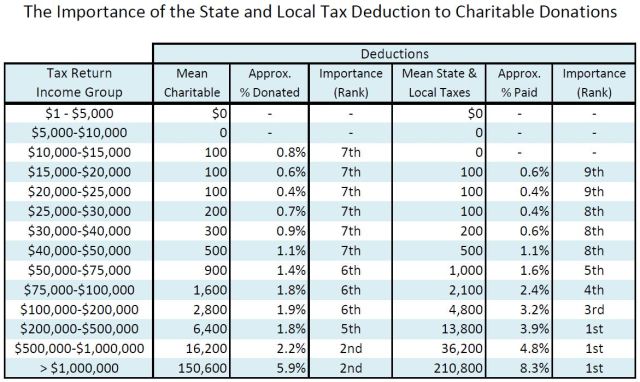
This table shows the importance of the state and local tax deduction to those who give the most to churches and other charitable organizations.

Tax Deduction Comparison

– Numbers derived from an interactive graphic published in the Washington Post -(https://www.washingtonpost.com/graphics/2017/politics/tax-breaks/?hpid=hp_no-name_graphic-story-a%3Ahomepage%2Fstory&utm_term=.b48a85c5a445)

Most charitable gifts come from wealthier people, but perhaps less obvious is that the tax benefit is a great incentive for some to give generously.

I’m a church treasurer and annual pledges range from a couple hundred dollars to tens of thousands, plus there is a lot of additional giving as needs arise such as hurricane relief over the last month or so. I don’t know the income levels for each donor in the parish, but there are definitely some who have paid off their mortgages, don’t qualify to deduct medical expenses and have a high enough income that they receive very little or no personal or dependent exemptions.

Real estate taxes vary widely based on the community in which a person lives. In Alabama, the property tax burden for a median priced house is only $543 per year. Targeting people in the $200-$500,000 range of income for this analysis, a brand new 4 bedroom, 3-1/2 bath, full brick house with granite countertops and hardwood floors about 20 miles outside Birmingham is probably a better comparison. The property taxes on such a house would be about $1,200. The point here is that the real estate tax for an Alabamian family making $350,000 may be as low as $1,000 while the state income tax burden would be about $16,000.

Eliminating the deduction for state and local income taxes would cut out the #1 deduction for families with annual incomes more than $200,000. For those who have paid off their houses, almost all of their itemized deductions would have to come from charitable donations – unless they don’t donate enough to itemize their deductions. Even for those with a mortgage, there is still a big gap to fill before there’s any tax advantage from charitable giving. For a family with $5,000 in real estate taxes and $9,000 in mortgage interest, they would have to donate $10,000 more to see any income tax advantage by itemizing rather than taking the proposed $24,000 standard deduction. Considering the median charitable deduction was $6,400 in 2015 for returns in the $200-500,000 income range, that’s probably a hard sell for charities.

The higher taxable income will also likely be a deterrent to giving. Without the state and local tax deduction, the average family in the $500,000-$1,000,000 income range would have to pay federal income tax on an additional $36,200. That’s $12,670 more income tax paid at the proposed 35% top tax bracket. Despite the savings from the proposed tax rate changes for the people in the top 1%, it won’t be long before the new lower rate becomes the norm and the loss of the state and local income tax deduction morphs into a big government money grab. People are less charitable when they feel they don’t have control over their own money.

Should the GOP tax plan become law in something like its current form, difficult times are probably coming to many charities and to the people and institutions served by them.

Posted in Economics, Religion, U.S. Politics, Uncategorized | Leave a comment

The Grand Old Death Party

Yesterday morning I awoke to news that the latest Affordable Care Act repeal attempt had been tweaked to give more money to Alaska and Maine in an attempt to get the votes of Senators Murkowski and Collins. Secondly, I saw that the GOP tax plan will provide massive tax cuts to the very rich – on average, the top 1% will save $175,000 each year – and that our Republican elected officials are embracing some funny math to justify it.

While the Senate leadership has scrapped the ACA repeal vote in light of opposition from three republican senators, the end result of both these plans is death.

Throughout history all great empires have fallen and it is usually caused by internal strife rather than external attack. You will find very few people today who would not classify the United States as a divided country. We’re divided over economics, healthcare, race, our opinions on the purpose of a social safety net, among other issues. This weekend we were divided over anthems and football. Two-thirds of the country – including a fifth of the president’s supporters – believe that Mr. Trump has been acting as Divider in Chief.

The actions of the Republican Party seem geared to help their wealthy supporters rather than make decisions which strengthen the country. I’m sure many of them realize that companies are not likely to move operations to the U.S. based solely on a tax rate cut, especially when the country’s leaders project an image of instability.

Whatever tax reform results from the Republican-only approach will likely be temporary because there is good economic data which show tax cuts on the wealthy do not stimulate the economy. Just like Kansas’ failed tax cut experiment, a federal tax cut for the rich will not stimulate growth but will hasten the decline of the United States. Imagine the sales pitch:

“Move your business to the United States where you will enjoy low taxes and an undereducated and less reliable workforce in which many will need extra time off because they lack health, child and elder care options. Additionally, our political system is so divided that should the other side regain power in 2-4 years, you can expect your taxes to increase substantially. And we have great beaches.”

The GOP will push through the tax cuts to reward their wealthy supporters and justify it by assuming 3-4% economic growth. The Federal Reserve is on record with their plan to target growth at 2% to reduce the chance of inflation so the GOP’s growth projections are unrealistic.

The likely result: huge federal deficits with ever increasing debt and interest payments that will further reward the rich and squeeze the middle class. In other words, death to the American system that served us so well from the end of World War II through the turn of the century.

About the only fiscally responsible action that the GOP is proposing is the repeal of the Affordable Care Act. It’s not fiscally responsible because it will reduce spending on health care through efficiencies or better targeted healthcare. It’s because it will kill people and some of those people are currently collecting social security and racking up large medical bills paid by Medicare and Medicaid. Once they’re dead, the federal government saves a lot of money.

The problem with the GOP calculations is that their repeal will not affect the retired population as much as it will affect the younger working class which has traditionally been the support structure for the economy. By reducing the ranks of the insured by about 20 million, the GOP will cause people and institutions to die. The people are the many low and lower middle income individuals who currently have health insurance but would lose it. The institutions include rural hospitals and labor intensive businesses such as small farms which will have an unreliable workforce because of family health issues.

The Republican Party does not seem overly concerned about those deaths. The loss of small farms will further reward their large farm supporters who will be able to expand operations at a discount. Rural hospitals are expensive and reducing their number will help reduce the number of people on Medicare and Medicaid because the sick elderly won’t be able to get medical intervention in time. While some GOP candidates may lament the loss of elderly voters, the 2016 election showed that gerrymandering and divisive politics has made most of their congressional districts safe Republican seats so it’s an acceptable loss for the party of death.


Posted in Economics, Healthcare, U.S. Politics, Uncategorized | Leave a comment

Matthew 18:21-35 through the Filter of Three Books

Summary of the Bible Passage:

A rich guy owned a number of slaves. Slave #1 owed the rich guy the equivalent of about $16 million in silver but didn’t have it to pay back. The rich guy decided to recoup what he could by selling the slave and his family and all their possessions, but Slave #1 pleaded and asked for mercy and the rich guy gave it – he decided to cancel the debt and not sell the slave. Slave #1 was very pleased.

Slave #2 owed about $600 to Slave #1 and he couldn’t pay and he asked for mercy. Slave #1 did not grant it and threw him in jail until he could pay. The other slaves were upset about this treatment and told the rich guy. The rich guy summoned Slave #1, reinstated the huge debt and had him tortured as punishment for treating Slave #2 so poorly.

What Jesus’ audience was supposed to understand about this parable:

  1. The rich guy represents God,
  2. God has done so much for people (represented by Slave #1) that they could never pay Him back,
  3. God wants us to treat our fellow human beings (represented by Slave #2) with respect and fairness, and share some of God’s gifts with them,
  4. If we act selfishly, God will get pissed and punish us (Jesus’ message was about the Kingdom of God, or what Christians today call heaven).

The Three “Filter” Books:

  1. The New Jim Crow by Michelle Alexander (2012),
  2. Chasing the Scream by Johann Hari (2015), and
  3. Small Great Things by Jodi Picoult (2016).

I am writing this as a privileged, middle-aged (if I live to be 110) white male American. My wife & I grew up in small rural towns in lower middle-class to middle-class families. Due to innate abilities, good timing, some excellent choices and the opportunities the United States offers its citizens, we have jumped up the economic ladder.

Still, we have that experience of struggling with money – both in our early years together and as children in our parents’ homes. We had to weigh the cost of childcare versus the advantages of stay-at-home parenthood, for example, and for a few years, we had to juggle one car and – this is really hard to believe now – we kept the thermostat at 62F (17C) in winter.

Those struggles give me insight into how political decisions affect more than just those in my current socioeconomic class. I fear most of our elected officials on the state and federal level are unable to make the same connections because they may always have been in the privileged classes.

As a result, we get policies and legislation based on beliefs which may not be based in fact. The prime example is tax policy. Many politicians state emphatically that cutting taxes on the rich stimulates the economy. There is definitive evidence that counters that claim (“Tax Cuts for Whom” by Dr. Owen M. Zidar). When taxes are cut for the wealthy, the windfall is most often saved or invested in ways that do not stimulate the economy, especially in a downturn. Over the two years following a tax cut, there is no localized job growth that results from spending by the wealthy.

Now for the bible passage.

Why is it that Christians in the United States are more likely than non-Christians to consider a homeless person to be lazy? Part of the answer may lie with how many white Christians relate to Mathew 18:21-35.

We privileged white people have produced a system in the United States which makes it much easier for us to succeed and for black and Hispanic people to fail. It began with slavery, continued on through Jim Crow laws and segregated schools, and graduated into immigration policy and mass incarceration. The resulting environment of concentrated non-white communities with high incidences of felonies form a virtual wall to prevent the potentially successful person of color from escaping.

We privileged whites have the means to move to neighborhoods with good schools – self-segregation to benefit our children with more educational opportunities. We aren’t geographically restricted because commuting options abound where there’s money. We are also more likely to save for college and as a result, white college graduates typically have much less student loan debt than black and Hispanic graduates. Less debt translates into higher credit scores and more job and housing opportunities.

This healthy financial start works its way through and builds generation after generation until we end up with the rich guy from the Matthew passage. (Yes, I know that a man living 2,000 years ago in the Middle East wouldn’t be white, but it’s the ‘rich’ part that matters for this analysis.)

Today’s wealthy people own many of the businesses that thrive off the needs of those less fortunate, and in the United States, the less fortunate are more likely to be black and Hispanic. The rich own the rental houses and apartments, the fast food restaurants, the high-interest lending establishments, and the tax preparation franchises.

The people at the bottom of the socioeconomic ladder may have monetary debt or just a huge barrier to advancement because it takes money to make a step up the ladder. They can’t move to an apartment in a district with better schools because they will need capital for the security deposit and moving costs.  For many people, there is no money left over from the paycheck to save for such a move. They are in debt – one way or another.

So back to the Matthew parable. Wealthy people own the property and own poorer people’s debt. The system means that poor people owe the rich money or services, but once they break the rules, all bets are off. If they can’t make it to work because their car broke down, they can be fired. If they can’t pay rent because they lost their job, they can be evicted. If they are begging on the street because they are homeless, they should get a job and stop being a burden on society.

With respect to mass incarceration, if they possess or sell drugs – one of the few ways to make money in some neighborhoods – they should be labeled felons and sent to prison. It’s a vicious cycle for the poor.

So privileged white people are the rich man from the parable, right? That’s not what Jesus was teaching – God is the rich man.

The privileged white people are Slave #1. According to what Jesus was teaching his Jewish followers and what most Christians believe today, God has done so much for His people that we can never repay Him. God has forgiven us this debt – we don’t have to pay it back.

The disadvantaged in the United States are represented by Slave #2. He owes a debt to those better off. It’s a burden, but may eventually be paid off if they can go long enough without another problem cropping up. We, however, are on the lookout for broken rules – and there are many, many rules. We want them to be fiscally responsible even as we squeeze them financially and make that difficult. We want them to use the products we sell or rent, but punish them if they don’t pay on time. We want them to support themselves and their families, but go out of our way to ensure that higher pay and benefits are not written into law. We will throw them in prison if they don’t follow our rules just like Slave #1 does to Slave #2.

You would think that Christians would have a problem with how they treat the less fortunate if they believe this parable told by Jesus. God is going to be pissed at us privileged white people and we’re going to be punished. Shouldn’t that modify our behavior? Wouldn’t that mean we would be more compassionate to those less fortunate than we are?

Only if we think of ourselves as Slave #1.

If we relate more to the rich man, the formula changes. The rich man shows both compassion and retribution just as we may rally around a black inner-city student who defies the odds and gets accepted to Harvard, but throw a 14 year-old in jail for selling pot. The rich man will honor those who guard our freedom and safety (the military and police), regardless of race, but will harshly punish those we perceive as threats (immigrants, black youths wearing hoodies in their own neighborhoods, black drivers). They look at the Slave #1/Slave #2 relationship and think of black-on-black violence and muse, “Why can’t they behave more like us?”

I suspect that when most white Christians read Matthew 18:21-35, they think they are the rich man. Just like him, they have the money and power, they want the rules followed, and they can be charitable when the situation warrants it.

That’s not what Jesus was trying to teach, but then again, it may be hard for many modern white Christians to relate to the 2,000 year old message. After all, Jesus spent a lot of time talking about how corrupt those in power were – a difficult concept for the privileged white class to wrap their heads around.

Posted in Economics, Religion, Uncategorized | Leave a comment