Short Term vs. Long Term Options

I’m a little annoyed with myself. I wrote a post a month ago about how I thought Paul Ryan could win this year’s election if he ran as an independent (“Prediction: The Next U.S. President will be the Third-Place Finisher from the General Election”). While I wrote that post as an curiosity, I realize now that I actually want this to happen. It is not that I think a conservative president with a conservative House of Representatives and potentially supermajority Republican senate after 2018 would be good for the country. I actually believe the opposite.

I feel that conservative fiscal policies are misguided. The conservative tax strategy is to cut taxes on businesses and the wealthy to stimulate the economy. Most tax plans also cut credits and that would result in a tax increase on lower income taxpayers. Economic research shows that tax cuts on the top 10% earners do not stimulate the economy over the following two years, while tax increases on the bottom 50% earners cause a significant drag on the economy. Additionally, the likely social safety net cuts under such a government would affect the poor and cause a further drag on the economy.

I believe the economic policies enacted by a conservative president with a conservative Congress would lead to an economic slowdown and a ballooning budget deficit. The growth in the deficit would be dampened for the first few years because there would be a one-time business tax reduction on the trillions of dollars of foreign income earned by U.S. companies and not yet “repatriated.” Assuming a one-time 15% “repatriating tax,” the federal government would receive about $325 billion in business tax income on those monies.

So what would happen? President Ryan would take office in January and the tax policies would be enacted as soon as July 2017. By early 2018, the social safety net cuts – including the repeal of the Affordable Care Act (Obamacare) – would go into effect and the drag on the economy would begin. Tax revenues will probably be lower because, even though business tax revenue would be higher from the repatriated earnings, individual income taxes account for a larger portion of federal tax revenues and the lower tax rates on the wealthy will greatly reduce their tax burden.

The U.S. economy would probably fall into recession sometime between mid-2018 and mid-2019, and the business taxes paid on repatriated earnings would begin to drop off around the same time. The deficit would balloon and the conservative government would be loath to enact any kind of stimulus spending program. This would likely be a deep recession from which recovery would be slow and difficult.

So, why do I want a president Paul Ryan In January 2017?

Remember that I’m annoyed at myself about this, but after some self-evaluation, there appear to be two reasons. 1) There’s a curiosity factor – the same kind of thing that gets someone excited about gossip in the workplace, and 2) To finally solve the debate: what is the best economic policy?

Curiosity
It would be an interesting experiment. All those tax and spending cuts would be enacted with the promise of returning to a strong economy similar to the post war years. The previous administration gets the blame if things don’t improve quickly enough. After nearly a year, the repeal of the Obamacare would become a burden on low and middle income families. Hospital earnings would be reasonably good, but personal bankruptcies and foreclosures would increase. Sole proprietor business owners will likely use the top tax bracket rate cuts to modernize operations and replace jobs with automation

Conservatives will need a new target if the recovery fails to meet expectations after a year. I don’t know who they will attack, but it will be interesting to see how things develop. I assume they won’t blame business owners for the lost jobs, so it will probably be a renewed attack on regulation.

End the Debate
What’s best? 1) Cut taxes on businesses and the wealthy to stimulate the economy and cut spending to moderate the deficit, or 2) Use taxes and government spending (“transfer payments”) to reduce the gap between the rich and poor and have a more equitable society?

Proponents of the tax & spending reduction option state that high taxes on the wealthy and too generous a social safety net for the poor both reduce incentive to work. It’s the “pull yourself up by your bootstraps” philosophy, and that those with more marketable skills should earn whatever the market will support. Taken to the extreme, this is a system which provides for a national defense, but little else – no Medicare, Social Security, postal service, medical research funding, NASA, minimum wage or environmental protection.

The proponents of generous transfer payments believe it is a matter of fairness and that government has a responsibility to ensure that its citizens are protected from famine, homelessness, denial of medical care and other ills.

Taken to the extremes, option one is a survival of the fittest strategy and option two is communism. Somewhere between the two extremes is probably the best economic policy, but if one extreme is enacted into law, we would find out what happens under those conditions. If the country thrives following the tax and spending cuts, we have our answer. The conservative plan is the best.

If, however, the deficit rises dramatically, bankruptcy of low and middle class families increase, and the country falls into a deep recession, we’ll know that the conservative tax and spending plans are not the panacea promised. It does not prove that large transfer payments are the best policy, just that tax & spending cuts are not.

Short and Long Term Options
I am annoyed with myself because I’m thinking of this as a game. Some Americans are well suited to weather whatever storm comes from enacting such a policy, and may even come out of a long hard recession in a stronger financial state. For others, however, the consequences would be devastating. There are many more people in the latter group.

This is not an experiment – it is real life. The popularity of Donald Trump and Bernie Sanders shows how dire the situation is for so many. They would not be able to survive a bad recession – a large number are still suffering from the last one. We would find the highest homelessness rates since the Great Depression, and the conservative solution would be to encourage churches to provide help.

No more playing around. It’s time we all show concern for everyone in this country and work together to ensure steady economic and job growth. We don’t want a bubble – they burst and cause pain. We want nice, steady growth, and a calming down of the rhetoric. It’s too bad U.S. Presidential election campaigns last about 3-1/2 years now.
Posted in Economics, U.S. Politics, Uncategorized | Leave a comment

The Nooks ‘n Crannies Generation

My wife and I are at the very end of the Baby Boomer generation. Because we’re at the tail end, we didn’t share the same experiences, nor do we have the same drives which typically describe that generation. There was no Woodstock for us because our Silent Generation parents didn’t go in for that kind of thing, and we weren’t old enough to go unchaperoned, even if we cared about the music at that age. The Vietnam War ended while we were still too young to have an opinion about it, and the spectacular accomplishments of the U.S. space program seemed almost commonplace to us.

We do not fit into Generation X either, although we share many characteristics with the older members of that group. We are called Baby Boomers solely based on the number of births in the United States during the years in we took our first breaths. And let’s face it, our experiences shape us so completely, and things change too quickly for a 21 year generation to make much sense. We need a new one.

I got the idea for a new generation from the back of a truck trailer that I saw on the highway a few days ago. Pictured was a Thomas’ English Muffin with squeezable jelly in the shape of a smily face. That seemed wrong. When I was growing up, the ads used butter not jelly, and the butter would pool in the muffin’s “nooks and crannies.” (This feels a little Pavlovian; I’m salivating at the thought of those ads from the 1970s.)

And so, I dub those born between 1958 and 1970 the Nooks ‘n Crannies Generation.

What are the experiences that shaped our lives?

The Cold War, for one. The Baby Boomers grew up with the Cold War too, but their experience was different. History showed that there was a good chance of a nuclear war which would destroy life as we know it. Wars happened every twenty years or so and each new war brought bigger, more devastating weapons with it. They experienced real fear during the Cuban Missile Crisis, and some helped dig backyard fallout shelters.

For the Nooks ‘n Crannies Generation, we were at most four years old during the crisis, and most were not yet born. We have no memories of it. By the time we were old enough to notice what was going on, the perception had changed. To us, the Cold War meant a lot of blustery talk which kept us from having a major, world-altering conventional war in our lifetimes. It also allowed for other pursuits to flourish; most of us thought a nuclear war would never happen, and we still do.

We benefited from the fruits of the earlier generations. We were quick to adopt computers as valuable tools, and while we didn’t have the buying power of the Baby Boomers, we helped drive product development with enthusiastic adoption of the things we found most useful. As a whole, we are a little less judgmental than our predecessors, and fewer of us have personal military experience or close relationships with those who have served. That doesn’t mean that we’re unpatriotic, but there’s a bit of disconnect with the armed forces. We recognize that social injustices deserve at least as much attention as overseas military concerns.

And then there are the ads. We grew up with three or four television stations and no way to fast-forward through the commercials. During a lull in advertising creativity, there appeared to be only one good ad on TV – “I’d Like to Buy the World a Coke.” But still, the other ads had their impact. So much so that I’m now dubbing our newly formed generation after one of them.

There’s another reason I’m gravitating toward the butter covered English muffin ad. While the Nooks ‘n Crannies Generation didn’t suffer from war in the same way as earlier generations, and we’ve generally enjoyed favorable economic conditions, we have been the victims of one insidious agent. I speak, of course, of the food pyramid.

The food pyramid was a mistake by the government. They meant well, but it was a huge mistake. Scientists noticed that heart disease was lower in people with lower blood cholesterol levels and made the unproven leap that our diets should be much higher in carbohydrates and we should eat very few meats and fats. The scientists and the government were aided in their development of the food pyramid by companies who profited from the farming and processing of grains.

While the food pyramid is no longer the recommended eating guide for us Americans, the damage has been done. Our generation and the next two have been fed large quantities of unsatisfying carbohydrates, and we would eat ever greater amounts in an attempt to feel satiated. We were supposed to limit our consumption of nuts, meats, olive oil, butter, cheese and other foods that make us feel full. We were supposed to throw out millennia of hunter-gather diet history to which our modern bodies had adapted, and switch to an unnatural diet based on highly processed carbohydrates and incomplete scientific data. And we went along with it.

Data began to show that the food pyramid was a bad idea, but it was entrenched. A whole lot of farmers and many large corporations profited from the food pyramid’s dietary guidance, and lawmakers were loath to act against those powerful voting and fundraising targets. Attempts were made to tweak the message – “eat more whole grain carbohydrates and fewer highly processed ones” – but the food pyramid remained. That strategy didn’t work well; the highly processed carbs taste the best, especially those with a lot of salt. Some studies also show that lab rats find sugar to be more addictive than heroine, and sugar is a carbohydrate, the base of the pyramid.

So, many of our generation have been damaged by the food pyramid. Obesity has grown by about 130% between 1990 and 2014 in the United States. Even if we know that too many carbohydrates are bad for our health and our weight, we were raised on that diet, so we can’t help ourselves sometimes.

Now you know why I chose to name our newly defined group the Nooks ‘n Crannies Generation. We crave the butter, and now we’re allowed to use it in moderation, but what are we putting it on? A highly refined carbohydrate – an English muffin. We just can’t escape that food pyramid.

Posted in Musings, Uncategorized | Leave a comment

Trump Twitter-Baiting

It’s entertaining how the U.S. presidential candidates are using Twitter this time around. Four years ago, Twitter was used to appeal to Millennials using upbeat messages designed to show how each candidate was worthy of their attention and support. As evidenced by his victory, Barack Obama did a better job of this than Mitt Romney, but the tweets were of an informative and socially polite nature. At least that’s how I remember it.

Four years from now, on the other hand, I’m pretty sure I’ll remember the nastiness of this campaign’s tweets. Donald Trump uses Twitter extensively and many of his tweets can be classified as attacks on his opponents. The media report Trump’s tweets daily because the personal nature of the attacks is newsworthy and keeps people coming back for more.

Trump’s Twitter opponents include other candidates, of course, but also those who have spoken out against him or have otherwise acted in a manner which the presumptive republican nominee feels is worthy of rebuke. In April, the New York Times published “The 217 People, Places and Things Donald Trump Has Insulted on Twitter: A Complete List.” Some examples.
1. Referring to Elizabeth Beck, lawyer: “she wanted to breast pump in front of me at dep.”
2. About South Carolina Governor Nikki Haley: “The people of South Carolina are embarrassed by Nikki Haley!”
3. About Fox News Anchor Megyn Kelly: “Can’t watch Crazy Megyn anymore”
4. After a Supreme Court decision: “my judicial appointments will do the right thing unlike (Chief Justice) Roberts”
5. Regarding Washington Post blogger Jennifer Rubin: “one of the dumber bloggers”

Donald Trump’s supporters don’t appear troubled by this vitriol. When questioned, they seem to either dismiss the comments as just part of campaigning, or they say they admire how Trump is putting an end to political correctness.

For the rest of the electorate, however, these attacks have an effect. Recent polls show that 67% of Americans have a negative opinion of Donald Trump (Washington Post/ABC News April 6-10, 1,010 U.S. Adults). That makes his chances of winning 270 electoral votes in November daunting, especially since a substantial portion of the electorate state that they would not vote for him.

To exploit this perceived weakness with the candidate, I suspect that we’re going to see months of Trump Twitter-Baiting. That is when people who oppose Donald Trump’s candidacy will tweet something designed to elicit a response. History shows that Mr. Trump will respond will personal attacks. If the original tweet originates with a woman, Trump’s response – especially if of a personal nature – may offend many women voters. There’s already an advertisement for Hilary Clinton in which women read derogatory comments spoken or tweeted by Trump.

The latest example of the Twitter war involves Massachusetts Senator Elizabeth Warren. It began following the Indiana primary on May 3rd when Warren tweeted “There’s more enthusiasm for @realDonaldTrump among leaders of the KKK than leaders of the political party he now controls.” She also accused Trump of building a “campaign on racism, sexism, and xenophobia.”

This is criticism of both Mr. Trump’s appeal and of his campaign strategy, but it was a measured statement. The tweet didn’t hit the level of personal insult, just implied insult. This is a traditional campaign strategy – you don’t call the candidate stupid, for example, you say that the candidate’s policies have no basis in fact thus implying stupidity.

Trump’s response to Warren’s tweet at a rally in Oregon was more personal. He called her a “goofus” and a “basketcase.” In the Twitter exchange, trump also called her claims to Native American heritage “phony” and Warren also turned personal by calling Trump a “bully who has a single play in his playbook—offensive lies thrown at anyone who calls him out.”

After a few days lull, the war heated up again last week. Trump called Warren “one of the least effective Senators in the entire U.S. Senate” in a tweet and she responded by calling out the presumptive republican candidate for his stance on Wall Street, the minimum wage and women.
1. Trump: “Goofy Elizabeth Warren has been one of the least effective Senators in the entire U.S. Senate. She has done nothing!”
2. Warren: “We get it, @realDonaldTrump: When a woman stands up to you, you’re going to call her a basket case. Hormonal. Ugly.”
3. Warren: “You care so much about struggling American workers, @realDonaldTrump, that you want to abolish the federal minimum wage?”
4. Warren: “You’re so concerned about Wall Street, @realDonaldTrump, that you say you’d “absolutely” repeal Dodd-Frank?”
5. Warren: “When asked what gov should stop doing, @realDonaldTrump said overseeing banks! How can you be tough on Wall Street by letting them off?”
6. Warren: “Your policies are dangerous. Your words are reckless. Your record is embarrassing. And your free ride is over.”
7. Trump: “If the people of Massachusetts found out what an ineffective Senator goofy Elizabeth Warren has been, she would lose.”
8. Trump: “Goofy Elizabeth Warren is now using the woman’s card like her friend crooked Hillary. See her dumb tweet ‘when a woman stands up to you…'”

Donald Trump is trying to get the monikers to stick. He had good results with “Lyin’ Ted Cruz” and he’s trying to get “Crooked Hilary” and “Goofy Elizabeth Warren” into the American lexicon. It might be a little harder with the latest terms. There’s little dispute what a lie is and it was easy to find examples of Ted Cruz’ exaggerations for Trump to label as lies. All politicians tweak the facts, but Mr. Trump was very good at labeling Cruz’ statements as lies.

“Crooked” and “Goofy” are a little different. Crooked generally means financial impropriety and Clinton has not been accused of that. Goofy is something that can entertain us under the right circumstances. They’re not black and white terms. Also, Trump seems very much like a playground bully by attacking these two women with name calling, even though he could rightly claim of Warren, “She started it!”

I fully expect to see democratic political ads in the coming weeks in which Mr. Trump’s own words are used to portray him as a bully who picks on women. Clinton, and especially, Warren will be hailed as standing up for all people who have been subjected to unfair treatment.

This is a sound strategy. Women vote in higher numbers than do men, and in the past several elections, women have chosen the democratic presidential candidate by a good margin. The more often the Democratic Party can label Donald Trump as anti-women using his own words, the more likely Hilary Clinton will win the women’s vote and the 270 electoral votes needed to become president.

So prepare yourselves for the potential onslaught. There will likely be Twitter battles a couple times a week for the next five months, and if the exchange is with a woman who is overweight or unattractive in Trump’s opinion, his tweets may attack the person’s appearance. And the media will cover it, of course – it will drive the ratings.

Posted in U.S. Politics, Uncategorized | Leave a comment

Unintended Consequences – 401(k)s and RFRA

It’s not uncommon for a program designed to help one group to get coopted by others and end up harming some people. The Religious Freedom Restoration Act of 1993 and 401(k) retirement plans are two examples of unintended consequences.

401(k) Plans
Let’s start with 401(k) plans. Most employees are familiar with this retirement savings plan option. This section of the Internal Revenue Code provides for favorable tax treatment on retirement savings and certainly seems like a good idea. It allows employees to save for retirement with a portion of their salary or wages that is not subject to income tax. When originally devised, however, it was not intended to be a program for the masses.

At the urging of large employers in his district, republican Representative Barber Conable of Upstate New York suggested a program that would allow for tax-deferred savings for retirement. Conable was the top republican on the House Ways and Means Committee and the suggestion ended up in the hands of Committee staffer Richard Stanger who was the chief author of the 401(k) section of the tax code.

According to Hedrick Smith, author of Who Stole the American Dream, the concept for 401(k) plans originated with Xerox and Eastman Kodak because they were looking for an additional benefit to offer their executives. The top tax rate in 1978 was 70% and the ability to shield some of high earners’ income from 70% taxation was a significant benefit.

Things changed in 1980 when benefits advisor Ted Benna locked onto the 401(k) as a way to make the program more universal. At the time, the rules allowed for a 25% contribution into a 401(k) plan not to exceed $30,000 per year. This was a substantial increase over traditional deferred benefits plans which contributed 6% of an employee’s income on average toward future pension payments.

Four things happened which made the 401(k) a much less valuable tool for retirement.
1. While 401(k) plans provide for higher investment levels than traditional pension plans, workers today only invest 1.4% of their income on average in 401(k) plans;
2. Once companies adopted 401(k) plans for their employees, they did away with the traditional pension plans in which they had typically invested 6% toward employees’ retirement;
3. Investment management companies latched on to 401(k) plans as a good income source and charged high management fees which greatly reduced the employees’ 401(k) plans’ performance; and
4. Individual investors were more likely to choose risky investments than were seasoned pension fund managers which also reduced the employee’s investment performance.

So the 401(k) was not a bad retirement investment instrument, but it has morphed into a vehicle of high fees and poor performance, and allowed employers to drop traditional pension plans which historically provided a steady income to retirees.

RFRA
What about the federal Religious Freedom Restoration Act of 1993? RFRA, as it is known, is a federal law which “ensures that interests in religious freedom are protected.” The bills were introduced by two liberal lawmakers (Sen. Kennedy, D-MA and Rep. Schumer, D-NY) in response to an unpopular 1990 Supreme Court decision, and in what seems inconceivable today, passed the House unanimously. All but three senators voted in favor of the bill and President Clinton signed it into law.

The Supreme Court decision in 1990 that prompted this law (Employment Division v. Smith) upheld the firing of two Native American drug counselors for ingesting peyote during a Native American Church religious ceremony. The lawmakers’ intent was to entrench protection from repercussions as a result of the free exercise of religion. A later Supreme Court decision determined that the federal law could not be applied to state jurisdictions.

While the original religious freedom law was intended to protect a person whose religious practices may put him at odds with an employer or other entity with power over him/her, current state religious freedom laws seem to have a different purpose. While claimed to protect business owners from repercussions should they refuse to serve a customer with whom they have a religious objection, many of these laws have become a means to restrict the rights of lesbian, gay, bisexual and transgender people (LGBT).

Let’s look at Mississippi.

Section 2 from Mississippi’s “Protecting Freedom of Conscience from Government Discrimination Act.”
“The sincerely held religious beliefs or moral convictions protected by this act are the belief or conviction that:
(a) Marriage is or should be recognized as the union of one man and one woman;
(b) Sexual relations are properly reserved to such a marriage; and
(c) Male (man) or female (woman) refer to an individual’s immutable biological sex as objectively determined by anatomy and genetics at time of birth.

There’s no doubt why this law was enacted. It was written to restrict the rights of LGBT individuals and entrenched that discrimination into law. Under this legislation, it is legal to refuse service to LGBT people including making it legal to fire a person for being gay and evicting a tenant for being a lesbian.

This was not the original intent of the 1993 federal law, but that language has been coopted to change the protection from those will little power (employee) to those with greater power (landlord, employer, business owner).

Posted in Economics, U.S. Politics, Uncategorized | Leave a comment

Republicans for Clinton!

You’ve probably heard of several prominent republicans who feel unable to support Donald Trump’s bid for the presidency and have stated so publicly. At least one claims that Hilary Clinton is the most conservative candidate left in the race. At the same time, there are vocal calls for a viable third party candidate, plus calls for party unity to get behind the Trump candidacy. These are interesting times indeed.

All this chaos on the republican/conservative side makes the democrats happy, but there are good reasons why foreword thinking republicans may want Hilary Clinton to win the election in November. The tricky part is to figure out how to let the presidency go to the democrats, but retain control of both houses of Congress. If that can be accomplished, the republicans can look forward to large gains in 2018 and 2020. Donald Trump may actually help them achieve this goal.

To quote Ricky Ricardo from the I Love Lucy show, “Let me ‘splain.”

Donald Trump is not your traditional republican candidate. Consequently, there may not be much of a “coattails effect” for the republicans running for state and national legislative seats. Because of his political outsider persona, Mr. Trump’s fervent supporters won’t necessarily feel that they also should vote for the other republicans on the ballot in November.

But this also means that it’s possible for republican candidates to win elections even if Trump loses the presidency. Unlike the higher turnout by Obama supporters which resulted in net democratic gains in 2008 and 2012, Hilary Clinton could win this presidential election because of a lower than usual turnout of conservative republican voters for Trump. Those voters may still vote for the other republican candidates on the ballot if they’re dedicated to republican values, but can’t stomach Trump as president.

If that happens, what do we have for the next two years?

A democratic president for an unprecedented third consecutive term for the first time since Franklin D. Roosevelt in 1944, and a republican House and Senate. While conservatives won’t be thrilled that the vacant Supreme Court seat will be filled by a democratic appointee, it’s probably a minor setback in the long range game plan. If Clinton wins the election, the Senate will probably go ahead and confirm President Obama’s appointee, Merrick Garland. He is not overtly liberal and he’s older than the typical appointee so his tenure may not be as long as the likely appointees from a President Clinton.

The midterm elections in 2018 are the real prize for the republicans. Thirty-four senate democrats come up for reelection and many are vulnerable. For a very long time, midterm elections have favored the party which doesn’t hold the presidency. If Hilary Clinton is president, it is not unreasonable to believe that the republicans could win a supermajority in the senate in 2018 and increase their seats in the House of Representatives.

It’s probably safe to assume that the republican Congress would continue its policy of obstruction during a Clinton administration and in 2020, Hilary Clinton may have few accomplishments to point to during her reelection campaign. While Congress has a very low approval rating, most Americans feel their particular representative and senator are doing a fine job and should be reelected. Consequently, Congress risks little with an obstructionist strategy and the potential gain is huge.

If things work out for them, the republicans will hold the presidency, a polarized but largely conservative House of Representatives and a supermajority in the Senate on Inauguration Day 2021. This would ensure widespread adoption of conservative policies and a potential stacking of the Supreme Court with conservatives for a generation who would overturn Roe v. Wade and other decisions unpopular with those on the far right.

To those of us in the dwindling political center, this is a scary prospect, but I understand why many republicans may want Clinton to win in November.

Food for thought, I suppose, but other than writing about it, I’m not sure there’s anything I can do. It makes me feel like a deer frozen in the headlights of an oncoming car. I like the country in which I was born and I’m afraid it will be a very different place next decade. God bless America – we may need that blessing in the coming years.

Posted in U.S. Politics, Uncategorized | Leave a comment

Fitbit-Inspired Parking Manipulation

On Christmas Eve a few years ago, I was trolling through a mall looking for a couple gifts for my wife. That’s a stressful situation. I only go to shopping malls once or twice a year and I don’t enjoy it, especially if the mall is crowded as is generally the case on December 24th. It is because of such experiences that we give experiential gifts these days. Our gift this past Christmas was a trip to Italy a few months later with our grown children. It’s a little nerve wracking to conclude that you haven’t gotten enough stuff for your loved ones, and now you have to go to a mall and hope for the best.

On that particular Christmas Eve trip to the mall, however, I did well. I bought my wife a Fitbit. I hadn’t heard about the new generation of personal activity trackers, but the sales person told me all about it and how much his girlfriend loved hers. I knew that I was accepting the sales pitch out of desperation, but it this case it worked – my wife loved the gift.

Almost immediately, our walks on the neighborhood paths changed in character. “Steps” started guiding my wife’s exercise decisions and our walks became less leisurely. We began walking faster because that would yield more steps over a given time. Her Fitbit also recorded flights of stairs or flight-equivalents of hills. I hadn’t realized at first that her frequent trips up the stairs in our house only to return a moment later were not a sign of forgetfulness, but a quest for flights.

She was not alone; there seemed to be a Fitbit cult. Funny stories started showing up online about the sometimes baffling behavior of women and their confused and embarrassed husbands. These articles were written by the women. They considered it funny how the Fitbit changed their behavior. They thought nothing about sticking their hand down the front of their blouses in public places in order to retrieve the Fitbit from their cleavage so they could check the number of steps so far that day. They also seemed to enjoy their husbands’ embarrassment during these times.

Men began to join the cult. One of the funniest stories I’ve seen was written by David Sedaris and published in The New Yorker (http://www.newyorker.com/magazine/2014/06/30/stepping-out-3). I don’t want to give many details here, but suffice it to say that Sedaris become almost enslaved to the Fitbit. Read the article if you have the chance – it’s a good one.

I got a Fitbit about a year and a half ago. It hasn’t changed my life as completely as it has for others, but there have been some incidences. I have a fairly active life as measured by steps taken, but I’m often too busy to get the exercise I really would prefer – running or other aerobic activities. Still, that daily steps total is compelling, especially toward the end of the day, and even more so when I’m on vacation.

Two examples. My son invited me to a 5-day “workweek” Fitbit challenge and I was on vacation in Las Vegas. Well, shortly after midnight on the first day of the challenge, I went for a long walk on the Strip and received a text from my son the next morning which read, “How did you walk 14,000 steps already?” I had to smile – my evil plan had worked.

A couple months later, I let the steps goal get the better of me. It appears to work on the same part of my brain that makes it hard for me to throw away food. My son and I hiked the Grand Canyon. To be more specific, we did exactly what the signs at the rim warn against. We hiked from the rim, down to the bottom, along the Colorado River, across the bridge, up the tributary to Phantom Ranch, and back in one day. According to my iSmoothRun app, we hiked 21.5 miles with a total elevation increase of 8,300 feet in 8-1/4 hours. A very good hike, but also very exhausting. Still, when we got back to the house, the Fitbit goaded me on. With about 25 minutes to the end of the day, I was at 48,000 steps. I went for a walk around town to get to 50,000. There’s a hint of obsession there.

The Fitbit does not have the same effect on me these days. I rarely check the daily total, but I still keep it in my pocket and the steps add up. In a little less than a year and a half, I’ve accumulated close to 6.5 million steps. Actually is more than that. Sometimes the battery dies and I don’t notice for a few days.

The main lasting effect from the Fitbit has to do with where I park when I go somewhere. I never park close to the entrance anymore, but way out in the empty parts and get a number of steps before I even get to the front door. And that add up – it’s a few hundred extra steps at each stop. And that has given me an idea.

I live in a state with a high obesity rate in a country with a high obesity rate. As determined by a body mass index (BMI) of 30 or more, 30.7% of adults in Michigan were obese in 2014. This is a 133% increase over the 1990 obesity rate of 13.2%, which is a typical increase for the United States. The most obese state is Arkansas with 35.9% adults falling into the 30+ BMI category.

What if the overweight and obese citizens of Michigan are forced into taking more steps? That may improve the overall health of the people and reduce spending on chronic health issues like diabetes and heart failure. Health insurance rates for everyone in the state may go down, or at least grow more slowly, and state and federal spending on healthcare may also decrease. It sounds like a good situation.

So how do we force these steps? Big government program? Probably not – Michigan has a republican governor and state legislative bodies. No, my idea involves parking manipulation.

Those of us who like to get those extra steps by parking far away from the front door of a business may want to consider taking those closer spots in front of the businesses on the other side of the plaza and walking from there. We still get our extra steps, but we may also force extra steps for those who are less inclined toward exercise. They would now have to park where available and walk further to the front door.

Over time, this plan could lead to weight loss for the overweight and obese residents of Michigan. I can see two potential negatives though. Our parking plan may be noticed by others and there could be a backlash. I do not wish to have my car vandalized by an angry mob (okay, it probably wouldn’t go that far).

The other possibility is that this parking strategy may actually damage the health of those we’re hoping to help. How? The cumulative effect of never finding a parking space close to where you’re going could cause anxiety and depression instead of weight loss. You never know how people will react to such things. I think it’s worth a try though. I suppose I should create a movement on Twitter – #healthyparking perhaps. How does one go about doing that, I wonder?

Posted in Uncategorized | Leave a comment

Heaven and Hell

I don’t actually have time to write a post today. I’m upgrading a bathroom in our vacation rental house in Traverse City, Michigan and have painfully little time to get it done. I also have to do a lot of other work – put out the outdoor furniture, buy and assemble a new gas grill, change locks, touch up the paint, etc. I should be taking care of that stuff while I’m waiting for the joint compound to dry in the bathroom so I can paint the walls, but I’ve been delayed by my own mind. I started thinking about heaven and hell.

In a Pew Research Center study published on November 10, 2015, 72% of Americans said they believed in heaven and 58% believed in hell in 2014. These numbers are little changed from Pew’s first Religious Landscape Study in 2007 in which the 74% of Americans reported believing in heaven and 59% believed in hell.

There are considerable differences in belief in an afterlife based on religious affiliation. The highest overall belief is found in historically black Protestant denominations (93% heaven, 82% hell), although evangelical Protestant religions (88%, 82%) and Muslim believers (89%, 76%) are close behind. Roman Catholic (85%, 63%), Orthodox Christianity (81%, 59%) and mainline Protestant denominations (80%, 60%) are all in the same ballpark. Sticking with Christianity, the largest gaps in beliefs between heaven and hell are found in the Mormon (95% heaven, 62% hell) and Jehovah’s Witness (50%, 7%) faiths.

Other than Islam, non-Christian faiths show less of a tendency to believe in heaven and hell as demonstrated by the Jewish (40%, 22%), Buddhist (47%, 32%) and Hindu (48%, 28%) numbers. Perhaps a little surprising, 5% of atheists believe in heaven and 3% believe in hell.

Since I’m trying to make this a quick post, I’m going to draw from memory and not look everything up. Sorry about that, but I really should get back to work.

Throughout most of the Jewish texts when taken chronologically as written, hell was just the place you went when you died. It was called Sheol, and when one Jewish king called back a dead profit from Sheol in an attempt to get some good advice during a troubling time, he was severely scolded by the profit. The profit wanted to go back to rest in Sheol. It doesn’t sound like the same fire and brimstone place we are warned about today.

By the time of Jesus, however, hell was thought to be an unpleasant place. Jesus is quoted as saying of hell that it is the place where fire never ends and the worm never dies. This symbolizes both external and internal pain and destruction. What changed in a couple hundred years prior to Jesus’ birth which led to this deviation from earlier believes?

Alexander the Great happened. Greek mythology had a different impression of the afterlife and it made its way into Jewish belief.

Let’s start with heaven. After Alexander’s death, his kingdom was divided among his generals who did not rule with the same respect for other cultures as their deceased leader. Well before Alexander, Israel and Judah were relatively small peoples surrounded by larger, better organized armies. Israel in particular was close to an active trade route and was lost to conquest by the Assyrians in the 8th century BCE (Before Common Era).

Side Note: Israel and Judah were the descendants of Jacob’s twelve sons (kind of – Joseph’s two sons were adopted by their grandfather, Jacob, making it thirteen tribes). One of the tribes – Levi – were priests and temple functionaries dispersed through the other tribes and consequently had no land of their own. That left the descendants of twelve sons as the tribes which held territory. After Solomon’s death, the united kingdom of Israel was split into a northern kingdom (Israel) and a southern kingdom (Judah). Ten tribes made up Israel and two tribes (Judah and Benjamin) made up Judah.

So the kingdom of Israel was destroyed by the Assyrians and lost forever. Actually, some people were moved to other areas in the Assyrian empire and others moved in. The cultural mixing led to the loss of identity of a separate people previously known as Israeli. (Another side note: the Mormon faith holds that these ten “lost tribes of Israel” were transported to the Americas and that Native Americans are their descendants).

So back to heaven. In the mid-second century BCE, faithful Jewish leaders led a rebellion against the Seleucid empire which controlled Syria in response to restrictions on Jewish religious practice and the introduction of worship of the Greek gods. During the battles, some beloved Maccabean leaders died painfully, and many followers thought that God would return them to life because their bravery and sacrifice were all for the cause of God’s chosen people and God’s directed religious practices. When they were not resurrected, the people believed that they had gone to a better place to be with God. Ironically, that leap of faith was probably influenced by Greek religious beliefs.

And heaven was born. If you were specially gifted, or went above and beyond in your devotion to God, you would join him when you died. You didn’t have to wait until the end of time like everyone else.

What about hell? Since there was now a belief in an afterlife in the form of heaven, it wasn’t much of a leap to turn Sheol into fire and brimstone hell. If you got into heaven upon death because you were especially good, then the place you go to if you are not good in your life should be at least unpleasant. Okay, it should be more than unpleasant – it should be HELL. Jesus’ words show that this was an established belief a couple centuries later.

What about belief in heaven and hell? What do they do for us?

A 2012 study reported in Psychology Today on December 24, 2013, shows that there is a higher crime rate in countries in which people believe in heaven at a higher percentage than they believe in hell. The researchers Shariff & Rhemtulla argue that supernatural reward need to be balanced out with a corresponding belief in supernatural punishment.

In a 2014 study, Shariff & Aknin reported “We find that a belief in Heaven is consistently associated with greater happiness and life satisfaction while a belief in Hell is associated with lower happiness and life satisfaction at the national and individual level.” The researches concluded from a third study that “these differences are mainly driven by the negative emotional impact of Hell beliefs.”

I attempted to research more into whether belief in heaven and hell affects behavior, but it is a contentious issue. The first several pages of a Google search seem to contain results from those with vested interests. Religious groups want to push the benefits of belief and anti-religious groups want to downplay it. I didn’t find a single “.edu” source on the first several pages, and the only news report was over twelve years old. I could have looked a little deeper, but I should be painting the bathroom walls by now.

So, belief in heaven makes you happier and belief in hell makes you less happy. In the United States we believe in heaven at a higher rate than we believe in hell which might be one of the reasons our crime rate is the highest in the developed world.

But there is something that a strong belief in heaven does for you. If you truly believe that your mother, child, spouse or whoever is in a better place after death, you can handle that death better. Conversely, if you have a strong belief in fire and brimstone hell, and you worry that your loved one didn’t meet the criteria to get into heaven, you’re probably going to have a difficult time moving on from that person’s death.

I would like to research this more some day. Specifically, how is death viewed and handled in countries with a low level of belief in an afterlife, such as Sweden And Denmark? More later – just not sure when. I really better start painting.

Posted in Religion, Uncategorized | Leave a comment

Prediction: The Next U.S. President will be the Third-Place Finisher from the General Election

There’s a scene in Anne Tyler’s The Accidental Tourist that may apply to the selection of the next American president. While on a tour of Independence Hall, the protagonist, Macon Leary, attempts to make the tour a little more engaging for his 15-year-old niece.

    “If it weren’t for what was decided in this building,” Macon told her, “you and I
might very well be living under a dictatorship.”
“We are anyhow,” she said.
“Pardon?”
“You really think that you and me have any power?”
“You and I, honey.”
“It’s just free speech, that’s all we’ve got. We can say whatever we like, then the
government goes on and does exactly what it pleases. You call that democracy?”

This is the perfect year for an independent candidate to be elected president. I’ve written a longer, more detailed version of this post that I hope to get published, but I also wanted to outline the idea here.

The twelfth amendment to the constitution is the reason the country has had a two party system for the vast majority of its existence. Passed by congress in 1803 following the contested election of 1800 (Jefferson vs. Adams), the amendment was ratified in time for the presidential election of 1804. The amendment is available from the National Archives at http://www.archives.gov/exhibits/charters/constitution_amendments_11-27.html.

The twelfth amendment outlines the process for electing the president and vice president if none of the candidates receives a majority of the total electoral votes in a general election. For 2016, the magic number is 270. The House of Representatives will elect the president and the Senate will elect the vice president if no candidate receives that number of electoral votes from the general election on November 8.

The House has only been called on once to exercise its powers under the twelfth amendment. In 1824-25, the House chose between Andrew Jackson (99 electoral & 153,544 popular votes), John Quincy Adams (84 electoral and 108,740 popular votes) and William Crawford (41 electoral votes). The fourth-place finisher, Henry Clay, used his influence to persuade the House to elect Adams to the presidency.

The procedure outlined in the twelfth amendment provides a definite advantage to a conservative candidate in 2016. The House elects the President with a majority vote, BUT each state’s congressional delegation receives a single vote and the District of Columbia is excluded from the selection process. This means that highly populated states like California, Texas, Florida and New York have the same voting power as lightly populated states such as Wyoming, Vermont, Alaska and North Dakota.

States with low population densities are typically conservative strongholds. Sixty-eight percent (17/25) of the states with the lowest population density voted for Romney in 2012, while only 28% (7/25) of the most densely populated states voted for the republican candidate. Recall that Obama won the election by a comfortable margin. He had 8% more popular votes and 61% more electoral votes than Romney In 2012.

Since the twelfth amendment gives a single vote to each state’s delegation if the House of Representatives is to decide on the presidency, a conservative candidate would have a distinct advantage. There is another situation with nine of these states which heightens the effect. Eight states in which the 2012 popular vote went to Obama have congressional delegations which are majority republican, and New Jersey has an evenly split delegation. This means that a conservative candidate may pick up additional votes from states in which the electorate chose the democratic candidate, presumably Hilary Clinton. There is nothing in the twelfth amendment which instructs a state’s delegation to vote in a manner consistent with the popular vote.

I’ve been using the terms “conservative” and “democratic” for a reason, but I have yet to talk about the republican candidate. There’s a good reason for that – Donald Trump. Mr. Trump is the reason I believe an independent, conservative third candidate will be the next president.

Trump is very likely to be the republican nominee. He is a candidate with strong support among many voters – including some who would typically vote democratic – but he also has some important negatives.
1. Many conservatives do not trust that he is as committed to conservative social issues as he claims to be;
2. A substantial percentage of women say they will not vote for Trump because they believe he is sexist and would not support policies designed to treat women in a manner equal to men; and
3. The political establishment do not feel he has a presidential disposition, and would very much prefer a more traditional candidate.

So how will this play out? A conservative, independent candidate would join the race within the next couple months and target specific states so as to keep either Clinton or Trump from winning 270 electoral votes. The message is simple: vote for me because there is an empty seat on the Supreme Court and I can end abortion and secure Christian values forever. There would also be messages about solidifying second amendment rights, supporting farmers, repealing ObamaCare and cutting business regulations, but it’s the “family values” message that is the most important. Keep in mind that the candidate would not have to win all of these states, just a few to keep the democratic and republican candidates from reaching 270.

The targeted states are:
1. Alabama
2. Arkansas
3. Idaho
4. Indiana
5. Kansas
6. Kentucky
7. Mississippi
8. Missouri
9. Montana
10. Nebraska
11. North Dakota
12. Oklahoma
13. South Carolina
14. South Dakota
15. Tennessee
16. Utah
17. West Virginia
18. Wyoming

The candidate would also have to swing a few important states from Clinton to either Trump or him/herself to prevent Clinton from achieving 270 electoral votes:
1. Michigan
2. North Carolina
3. Ohio
4. Pennsylvania
5. Virginia

Political pundits believe these five states are leaning toward Clinton, but there are a lot of disgruntled ex-factory workers in all of them, and that is a demographic that likes Trump. The independent candidate’s message of stacking the Supreme Court for conservative values will not necessarily play well to many voters in these five states, but the candidate only has to prevent them from going to Clinton. He/She can help steer these states toward Trump with some negative advertising paid for by a Super PAC, not that there’s supposed coordination between the campaign and the Super PAC, of course.

There are a substantial number of voters who believe Hilary Clinton is not trustworthy. Congress has the power to highlight this negative opinion by conducting investigations over Benghazi and the Clintons’ email server during the campaign. It could backfire. The perception could be that Congress is attacking the only woman in the contest and her support may increase.

If the as-yet unnamed conservative candidate is able to win just a handful of the eighteen states listed above, and Michigan, North Carolina, Ohio, Pennsylvania and Virginia go to Trump, this dark horse candidate could become president, perhaps with less than 10% of the popular vote. That would be quite a coup, but also absolutely constitutional.

So who’s the ideal candidate? I don’t think Ted Cruz has a good chance of success; he is just too unlikeable. Sarah Palin is a bit too extreme, even for the House of Representatives, so I think she is out as well. It probably should not be one of the republican presidential candidates who signed the loyalty oath because he/she could be rightly accused of breaking the oath by running as a third-party candidate.

The ideal candidate is Paul Ryan. He is well liked by the political establishment and many voters. As the current Speaker of the House and as Romney’s running mate four years ago, he has had plenty of exposure. The voters know him. I believe that he would be elected by the House of Representatives as the next president if he were to run as an independent conservative candidate. He’s also most likely to force the election by the House because he can steal Wisconsin and a few other states from Hilary Clinton if he runs. Because of his public image, his message would not have to be so family values-oriented to win the conservative states, and that makes him more attractive in Michigan, Florida and Ohio, for example.

Of course, Paul Ryan doesn’t want to run for president and has stated that emphatically. It took a great deal of persuasion to convince him to accept the position of Speaker of the highly dysfunctional House of Representatives. I’m not sure he’s ready to deal with the House as the President.

A cold chill just ran up my spine. This situation seems a little like Frank Underwood’s rise to the presidency on Netflix’s House of Cards. Underwood schemes and puts others under his control with political blackmail to achieve his aspirations. He’s even capable of committing crimes, including murder, to silence those who would derail his plans.

But Paul Ryan is no Frank Underwood. Aside from his P-90X obsession (I’m channeling some jealousy here), and the misguided believe that tax cuts for the wealthy stimulate the economy and cuts in federal payments to the poor do not harm it, he seems a decent enough guy. But then again, so would Frank Underwood to most of the country. It is only we viewers who know Frank’s actual thoughts. He turns to the camera several times during every episode to tell us what he’s thinking. It’s chilling.

Posted in Economics, Religion, U.S. Politics, Uncategorized | Leave a comment

The Job Numbers Are Good. So Why Are People Complaining?

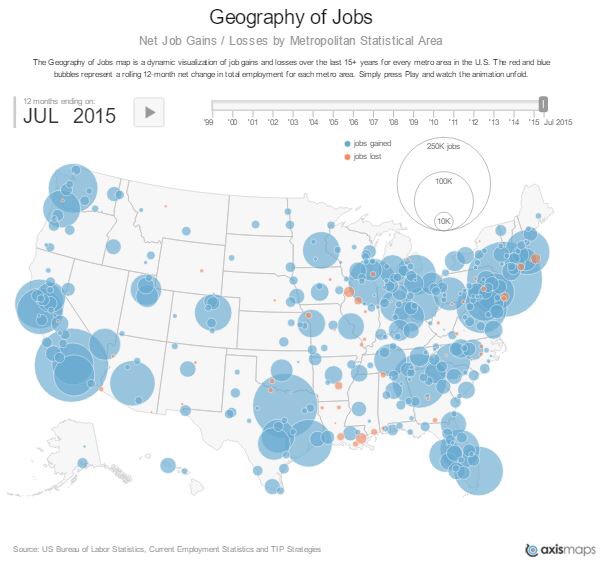
There is a fantastic website: http://tipstrategies.com/geography-of-jobs/. Go check it out.

It’s a geography of jobs map put out by TIP Strategies of Austin, TX, which is a privately held economic development consulting firm. Their map shows a running 12 month net job gain/loss representation for every metro area for which the US Bureau of Labor Statistics reports employment data. It’s an animation and covers the period from January 1999 to July 2015.

Hit the play button and watch the dot com bubble form and burst, the loss of manufacturing to China & other low wage countries when the rest of the country was doing well (see Detroit), the large job increases in Washington DC during George W. Bush’s first term, the effect of Hurricane Katrina, the housing bubble, more manufacturing losses (Detroit again), the Great Recession, the slow start to the recovery, and the steady job growth of late.

Now look at that July 2015 map. There are many more areas with job growth than with job loss, and the growth numbers are much larger. So why do we hear people complain so much about the economy and jobs?

image

Of course, one possible reason is that the jobs available in 2016 are not the same “quality” of jobs available seventeen years earlier. There is some truth to this. A lot of manufacturing has moved to plants overseas, both during good economic times and bad. This was obvious during the animation by the number of times Detroit was losing jobs during periods of job gains for the rest of the country.

Another reason why the media are showing us the bad news is because bad news sells. This isn’t a truism just in our current social networking age. There’s a saying from the days when most people got their news from television: If it bleeds, it leads. In other words, the bad news is what people remember and what they repeat to others.

Side note: I’ve noticed that NBC Nightly News spends a lot of time on weather related stories. I think it may be a version of “If it bleeds, it leads” because even though the weather disaster may be happening to people in a different part of the country or world, we have all experienced scary storms, so we can relate to the troubles others experience. It forms that basic connection that the media want.

So the media want people to have those strong emotional reactions to their reporting. For some, the daily negative messages will make them stop watching the news, but for many more, the bad news draws them in. That is why just about all media outlets interview people who feel desperate after loosing their jobs because of outsourcing (manufacturing, mining, customer support), or to holders of H-1B visas (IT jobs).

It is also why illegal immigration is so often in the news – “They’re taking our jobs!” But are they really? Do we native-born Americans actually want to pick strawberries for 12 hours in the hot sun? I did it in high school; my answer is “No!”

The U.S. economy created 215,000 jobs in July 2015 (net increase), but there we 53 metro areas which experienced job losses. Those 53 metro areas are generally small with an average population of 214,000. The total population of these 53 metro areas accounts for 3.5% of the country’s population.

In some cases, we know about situations which are causing the job losses. Atlantic City, for example, has lost its destination vacation status because of the large number of casinos which have opened closer to New York and Philadelphia. For the six metro areas in Louisiana which have lost jobs, low oil prices are to blame.

I compared the average of these 53 metro area with the top ten most populated metro areas and looked for patterns. About 85,498,000 people call the top ten largest metro areas home (New York, Los Angeles, Chicago, Dallas, Houston, District of Columbia, Philadelphia, Miami, Atlanta, and Boston with surrounding areas). That’s 26.6% of the country’s population. My findings:

From July 2014 – July 2015
53 metro areas: Lost jobs at a rate of 0.38% of total population;
Top 10 largest metro areas: Gained jobs at a rate of 1.06% of total population.

From July 2013 – July 2014
53 metro areas: Gained jobs at a rate of 0.34% of total population;
Top 10 largest metro areas: Gained jobs at a rate of 0.99% of total population.

The large cities with the fastest growth over the two year period are Dallas and Atlanta, the cities with the slowest growth are Chicago and Philadelphia.

During this economic recovery, job growth as a percentage of total population is faster in large cities than in small metro areas.

From March 2008 – March 2009
53 metro areas: Lost jobs at a rate of 1.20% of total population;
Top 10 largest cities: Lost jobs at a rate of 1.73% of total population.

During the Great Recession, job losses as a percentage of total population were worse in large cities than in smaller metro areas. The cities with the fastest rate of loss were Miami, Atlanta and Los Angeles, and the cities with the slowest job loss rates were Houston and Washington, D.C.

Between 2010 and 2015, populations have grown
by 1.7% in the 53 metro areas;
by 5.3% in the top 10 largest metro areas.

Conclusions
1. Because of farming and resource development businesses in rural locations and smaller cities, lower population metro areas may be buffered against the worst effects of a recession;
2. If a large employer shutters operations in a smaller community, the effects can be devastating for that metro area;
3. Larger cities may have a higher percentage loss of jobs during a recession, but they also tend to have stronger social safety net programs and subsidized public transportation to help people back into the workforce;
4. Larger cities seems to have better job gain performance during a recovery;
5. The country is becoming more urban, and finally;
6. The reason we hear so many stories about lost jobs and poor job prospects is because it’s an election year, and the media want people to hear bad news because it generally drives up ratings.

I would like to hear your thoughts on this post. Thanks.

Posted in Economics, U.S. Politics, Uncategorized | Leave a comment

Do “Religious Freedom” Laws Hurt Business and Cost Jobs?

There’s an interesting fight happening in Missouri. Usual allies are at odds over SJR 39, a proposed constitutional amendment that, according to proponents, protects those who oppose same-sex marriage from being forced to take part in any aspect of the celebration.

You would expect the religious right to be on one side and LGBT rights proponents to be on the other side. The surprise is that business groups are siding with the LGBT rights people against SJR 39.

If you’ve been paying attention to recent disputes about similar legislation in North Carolina, Georgia, Mississippi, and Arizona, the reason is obvious. Major companies have become very vocal in their opposition to laws viewed as discriminatory toward the LGBT community and are threatening to pull business from states in which the laws are enacted.

North Carolina has experienced quite a backlash to the law signed by Governor Pat McCrory late last month. Within a week PayPal announced that they would no longer build a global operations center in Charlotte which would have employed 400. Sharon Stone has cancelled plans to film a movie in the state and Deutsche Bank put their plans to hire an additional 250 in Cary on hold.

According to Greater Raleigh Convention Center president and CEO, Denny Edwards, they have lost six bookings worth $2.4 million and another sixteen bookings worth $44 million are in jeopardy. Greensboro Coliseum lost a concert by Bruce Springsteen and the E Street Band on April 10 because of the performers’ opposition to the law, and the 15,000 ticket holders will receive refunds.

There is plenty of anecdotal evidence that religious freedom laws negatively impact certain parts of a state’s economy, but is there any firm data that shows long term effects? To find out, I took a look at Indiana which passed such a law about a year ago.

According to Mark Fisher with the Indianapolis Chamber of Commerce, the city lost at least $60 million in convention business following the passage of the Religious Freedom Restoration Act. Governor Mike Pence issued a statement shortly after signing the bill into law which read, “If I thought it legalized discrimination in any way in Indiana, I would have vetoed it.” Within a week, Pence took steps to dramatically scale back the effect of the law, but the backlash was immediate and powerful. The #boycottindiana hashtag launched quickly on Twitter and helped channel worldwide condemnation.

So, has the Indiana law, even in it’s stripped down version, harmed the state’s economy? Probably.

I compared Indiana job growth as a percentage of employed persons versus that for the four states it borders. For private sector employment, the numbers show that Indiana has grown the slowest of the five states for the period from March 2015 – March 2016.

Illinois: +1.5%
Indiana: +1.3%
Kentucky: +2.0%
Michigan: +2.3%
Ohio: +1.8%

Business changes have occurred quickly in response to North Carolina’s law, but the decisions may have taken a little longer to work through corporate structures with respect to Indiana’s earlier law. Now that it’s been a year, we may be seeing the effect of business decisions made many months ago.

For the one month period from February – March 2016, Indiana is the only state in the country to experience a statistically significant loss of seasonally adjusted non-farm jobs. Indiana lost 9,000 job during that month while its neighbors Illinois and Ohio gained 14,700 and 18,300 jobs, respectively.

In addition to lost business spending, there’s a real risk of lost recreational dollars as well. Once a state is identified as discriminatory, some of the people who may have been considering a visit will change their plans to vacation elsewhere. The media have been eager to highlight the conflict, but some governments are joining in the controversy. The governors of Washington, New York, and Vermont have issued non-essential business travel bans to Mississippi and/or North Carolina following the enactments of their religious freedom laws, and yesterday, the United Kingdom issued a travel warning about anti-LGBT laws in U.S. states.

There seems to be a clear consensus from centrist and liberal governments and business leaders that religious freedom laws in conservative states are either discriminatory against the LGBT community or may be perceived to be so. Either way, it’s bad for business, and may have long lasting effects on the economies of the states which enact such laws.

It’s only been a year since Indiana’s religious freedom law went into effect – and one week less than a year since it was significantly weakened – so the data aren’t extensive. Still, Indiana has the slowest job growth rate in the region over the past year and it is the only state to lose non-farm jobs last month.

I think Indiana played with fire and got a little burnt, and it looks like several other states have decided to walk across the hot coals to join them. That sort of thing is a matter of faith after all, and should be protected under “Religion Freedom” laws.

Posted in Economics, U.S. Politics, Uncategorized | Leave a comment