Disenfranchisement – A Republican Political Strategy

I’ve rewritten this post three times, and with each rewrite, I’ve gotten more angry. It started as a post about how the Republican Party hasn’t won the women’s vote in a presidential election since 1988. It changed into an observation that legislation is often used to reward supporters rather than to help the country as a whole. This final iteration has morphed again into an accusation that the Republican Party uses practices which raise barriers to Americans who are more likely to vote democratic.

In this blog, I generally try to report facts without taking a side. Today, however, I state quite emphatically that the practices employed by republican elected officials to restrict voter turnout are harming the country.


Whichever political party is not in power spends a lot of time trying to convince voters that things are bad and it’s the other party’s fault. Things will only improve, the argument goes, if the balance of power shifts to their party after the next election. The voters buy the argument much of the time and major structural changes have become entrenched.

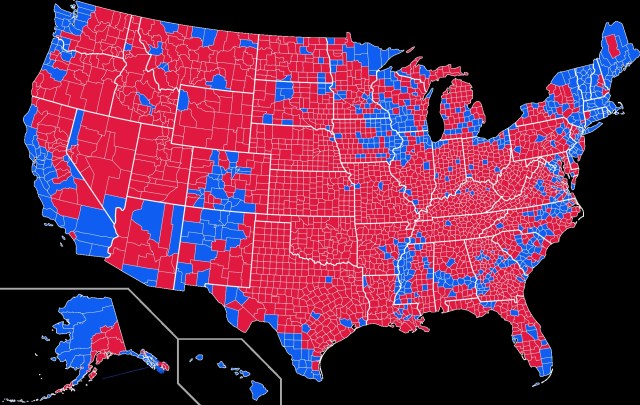
After the 2012 presidential election, one defiant conservative pundit attempted to discount Obama’s large electoral college victory by showing a map of the vote broken down by county and claiming that the country is overwhelmingly republican. Someone else on the program said that it looks like democrats like water. Check out the map for yourself.
 

image

That “democrats like water” statement was an interesting observation. Water has been a life-sustaining consideration ever since we humans began roaming the planet. Water is needed for many things, but cities grew near rivers, lakes and oceans because they facilitate trade. So as you look at those county election maps, notice that the democratic areas (blue) are the more populated ones. Cities tend to vote democratic, while rural areas tend to vote republican.

Is the country “overwhelmingly republican?” Yes, by area. No, by population. So what makes the United States a country – its people or its land? Both, of course, but should government programs meant to improve things in the country be concerned with improving the lives of all citizens or just the lives of the people who own the most land? I vote for the former – government should work to improve the lives of the greatest number of Americans possible.

Some republicans, on the other hand, looked at these election maps and came up with a strategy. While cities tend to vote democratic, suburbs are up for grabs. Many of the people who live in suburbs moved out of the cities in a search for low crime neighborhoods, better schools, lower taxes and more living space. With a very high percentage of rural districts voting republican and a substantial number of suburban districts doing the same, governors and state legislative bodies in many states are controlled by republicans. This is true even for states which are majority democratic.

With republicans in control of state government, they were able to reshape (gerrymander) the U.S. House of Representatives districts in many states to ensure a republican majority to the House. Not only do you end up with a republican majority, the effect of gerrymandering is that many of the republicans are on the political far right and many of the democrats are on the far left. Compromise is almost impossible in such a legislative body.

Here we are with a republican led House and Senate and a democratic president. The republicans would like to control both the legislative and executive branches after the next election. What’s the next step in this battle?

Let’s look at how Obama won the last two elections? In 2012, Obama won 51% of the popular vote compared to Romney’s 48%, but he won 62% of the electoral college vote. The states allocate electoral college “electors” on a winner-takes-all formula based on the state’s popular vote.

Michigan legislative leaders have suggested changing the system to award electors based on the majority vote in each congressional district. For a state like Michigan, this would likely provide more republican candidate Electoral College electors than democratic, even if the state popular vote is several percentage points higher for the democratic candidate. Other states would see similar results in such a system.

And this highlights a popular republican strategy. Through gerrymandered districts, voter identification laws, reduced polling stations and curtailed early voting opportunities, many state republican leaders attempt to disenfranchise the voters who are more likely to vote democratic. Whenever a barrier can be utilized to reduce minority and low income voter participation, the republican candidate has a better chance of winning.

So for at least a couple decades, the republican strategy has been one of exclusion. The national candidates make speeches in which they state that they are a party of inclusion, but the actions of many republicans indicate the opposite is true.

The primary system is largely at fault. In order to win the nomination in this ever more polarized country, the candidates have to blame America’s problems on the very groups that the national leaders say are welcome in the party. These contrasting messages aren’t working very well for republicans, so they double down on the exclusion policies. The latest shot in Michigan – disallow straight party voting because the data show republicans are more likely than democratic voters to make selections for the judges and state boards of education candidates that are at the bottom of the ballot.

So whom have the republicans attempted to disenfranchise?
1. Lower income individuals by requiring driver’s licenses or state id’s for people without cars;
2. People who work multiple part-time jobs (also low income) by reducing polling locations and hours;
3. People who move often (again, low income) by making it difficult to vote if their current address is different than that shown on their identification;
4. People in larger cities (all social classes, but generally lean liberal as a group) by attempts to overweight the power of rural districts, when viewed from a population standpoint.

There is another demographic which should cause concern for the republicans: women. A republican presidential candidate has not won the women’s vote since 1988, and Obama beat Romney by 11% four years ago. Just how will the republicans attempt to disenfranchise women? Here are a few options.

1. Change polling places to locations that are unpopular with women – perhaps smoke-filled cigar shops and gentleman’s clubs;
2. Put up “No Children” signs at polling places (won’t get them all, but it would knock down the numbers);
3. Hire drunk men to hang around near the entrances to polling places (probably backfire – I assume lower income women have to deal with these situations more often than upper income women).

Those suggestions are obviously tongue-in-cheek, but this situation is making me pretty annoyed.

This republican strategy of disenfranchisement means that they design their economic and social policies in a manner that helps the wealthy, the farmer and rancher, the landlord and business owner, but harms the people who do not typically vote for them. Donald Trump has expanded the republican appeal to the middle and lower middle class because of his promises of a return of America’s greatness, but I don’t believe most of these people would be pleased with the probable effects of his policies.

If the Republican Party adopted policies which would benefit the entire country, they would not need to have a strategy of exclusion. If they could prove themselves with results, the voters would flock to them, regardless of race, religion or class, and I would be one of them.

The general public doesn’t have a good idea of how the overall economy is doing; they just know what they see and hear. They see that there are more jobs locally, but perhaps the jobs are not of the same quality as they or their friends lost in the Great Recession. Maybe the local jobs are good, but they hear from conservative radio, television and presidential candidates that the country is in bad shape. Okay, the local jobs are good and the national jobs numbers are good, but the conservatives are saying that Obama is ruining the country with high deficits.

The media can shape the voters’ beliefs and the conservative voices speak more often and with more emphasis. Some of them genuinely believe that the country will be better off if taxes and regulations are cut dramatically so domestic business will flourish. Others, I suspect, are just stating the party line. The policies they propose benefit the wealthy much more than it helps the general public.

Let’s look at the results of republican policies. The George W. Bush era tax cuts and the wars in Iraq and Afghanistan have resulted in trillions added to the national debt, a bank-led housing bubble, and the resultant crash that brought misery to millions of Americans during the recession. Those tax cuts have also led to unprecedented wealth and income inequality in this country. The republicans have blamed the budget deficits on President Obama, but if you look closely at the annual federal income and outlays, the problems predated his administration.

Who is the American voter to believe? Why not me?

Tax cuts for the wealthy do not stimulate the economy, they just stimulate savings (economic research presented in previous posts). Some of that savings is in the form of real estate and high rent is the negative impact on low and middle income people. Affordable housing is becoming a major problem in cities and there is increasing homelessness because families cannot afford to live close to the available jobs.

What policies are more likely to work?
1. Simplify the individual tax code in a way to cut loopholes, deductions, credits and tax rates, but do not raise taxes on lower income individuals because that slows the economy and reduces jobs;
2. Build in tax incentives to promote business investment and eliminate tax incentives for the wealthy to save their money;
3. Simplify the business tax code so companies are willing to repatriate overseas earnings and are not tempted to change their corporate offices to other countries to reduce taxes;
4. Support social safety net programs, including childcare, that help those in need return to the workforce;
5. Means test social security benefits so they go to those in need, and not those who don’t (this is scary because retired people vote, but they’re still not likely to vote democratic);
6. Support health care programs so people have a measure of security (many republicans say they want to replace Obamacare; let’s hear their plans);
7. Rein in excessive spending (including some of the expensive parts of the farm bill such as crop insurance).

As with the retired, farmers and ranchers are not likely to vote for democrats.

Although the republican presidential candidates spend a lot of time telling the voters how horrible things are in the country, things are actually pretty good. There has been steady job growth, the dollar is strong, interest rates are low, tax revenues are increasing, and the 2015 deficit is lower than the deficit during most of the G.W. Bush years.

We are not in a bubble. We don’t want to be in a bubble because things seem great for a year or two, but many people are hurt and recovery is slow when bubbles burst. We want steady, boring, predictable growth and live within our means. The boom and bust cycle is a unfortunate way to run a country (or a business or a family, for that matter). I’m all for this steady improvement.

I watched last night’s Syracuse-UNC mens basketball game with a conservative friend and when the game got a little lopsided, we talked politics a little. Well, he talked a little – I may have spoken excitedly for a while.

On a conservative radio show, he heard about runaway federal government job growth and salary increases. The show’s host implied that we’re approaching a tipping point. Soon, he says, there will be so many people working for the federal government, or related to someone who does, that Big Government policies will dominate and the country will be doomed.

It’s simply not true. In late 2011, Congress and the President couldn’t agree on a way to cut spending and/or increase revenue to reduce the deficit. They came up with a poison pill idea called sequestration. If they were unable to come up with an agreement by the end of 2012, substantial across-the-board spending cuts would go into effect at the beginning of 2013 for social programs and military spending. It didn’t work – our government took the poison pill.

Because of sequestration, the federal government has been shrinking, not growing, but I have no doubt that the conservative host found a rare example and exaggerated it to the whole government. Fiscal year 2015 spending is higher than that in 2011, but 2012-2014 all had lower spending. At the end of 2015, Congress approved a huge package of tax cuts and spending increases which are reflected in the 2015 numbers. With representatives like these, who needs enemies.

I attempted to get tax help from the IRS this past week. Once I finally reached an agent, I was told that, due to budget cuts my question was “outside the scope” of what the IRS can address. Think about that. Congress has reduced the budget for the IRS, but has also made the tax code so complicated that many people have no choice but to spend hundreds of dollars on professional tax advice. There’s something wrong with this system.

Well, now I’m just ranting. Let’s fix congress – I’m not sure how, but they need to change the way they do business. Let’s allow every citizen of legal age to vote, not put up barriers which make voting difficult so the congressman can stay in power and reward his/her friends and supporters. Let’s look at economic research to develop the best policies for long term growth in the country. Let’s do something!!!

No wonder my friends think I sound like a Trump supporter. I’m angry enough and I think Congress is the problem. I’ll write about a lighter topic next time.

Posted in Economics, Make America Great Series, U.S. Politics, Uncategorized | 3 Comments

Anne Tyler Is My Favorite Author

I have an unusual attachment to Anne Tyler’s novel, The Accidental Tourist. I first read it when I was in my mid-twenties and newly married, but for some reason, I could identify with the protagonist, Macon Leary. Macon is a forty-two year old man who has difficulty with change and is recently separated after twenty years of marriage. His first reaction to this major life change includes odd and somewhat comical coping behavior, but as the novel progresses, a wonderful story of growth and redemption unfolds.

While Macon does not change outside of the novel, over the past thirty years I certainly have. In my twenties, I enjoyed the adventures typical of throwing oneself energetically into a new marriage and career. To add to the adventure, I was doing this in Manhattan. For a boy from a town with about 200 people and 2,000 cows that still doesn’t have a traffic light, those were exciting times.

My thirties was my favorite decade. We became parents, moved to Alaska, and I discovered and nurtured previously unknown talents. I became the fixer in the family. I took care of anything that was needed so my wife could concentrate on her career. I should have taken a photo of the organized rows of bagged breast milk in the freezer. There was a bit of Macon Leary in that level of organization.

I was also in great physical shape in my thirties. Tennis and cross-country skiing in the winter; tennis, hiking and cycling in the summer. I absolutely loved being a stay-at-home parent with preschool aged kids, a wife in the military who worked more reasonable hours than has been the case before or after, and the opportunity to spend quality time together. After all these years, I am still drawn to the mountains. I have some wonderful memories of family hikes in Alaska.

My forties were a little challenging. We moved twice, my mother-in-law died after a battle with cancer, I spent a lot of time driving kids around to one activity or another, and it took my wife four tries to find the right job. My body was also no longer in its best shape. During my forties, we purchased a few houses and I became a landlord, reentered the work force by managing a tax preparation office, and became the primary caregiver for my father-in-law. By the end of that decade, my time seemed more stretched than ever – rentals, job, kids, wife, house, father-in-law.

On my fortieth birthday, I wanted to do something for myself – go for a hike or get some other exercise while the kids were in school. Unfortunately, it was cold and very windy, but there was less than an inch of snow so I couldn’t go skiing. For hiking, my only option was a completely flat rail trail which would have been fine for cycling during the summer, but was depressingly boring and abrasively windy that day. Ten degrees below zero Fahrenheit in Alaska feels much better and is more conducive to exercise than thirty above and windy in Michigan. I didn’t last long on that “hike.”

Now I’m in my fifties and I have changed some more. I have decided to answer the call to become a writer, but know that many feel this call, and few succeed. I also feel that I have a talent for seeing the big picture and want to impart some of that knowledge to others so problems can be avoided. Mostly that has to do with politics and economics. I’m worried about the direction the country has taken in the past couple decades, but I also feel I can make a difference. This is a more public existence than I have had for a while.

And now I think back to my first encounter with Macon Leary. I believe the reason I felt such a connection with the character is because, at my core, I feel the promise of change and the power of redemption. Perhaps it is also that, like Macon, I do or feel things for which I am embarrassed. I assume we all do, but I feel it quite personally. I feel uncomfortable when a movie or book character exhibits strange behavior, whether in private or in front of other characters. If in private, I’m thinking, “Someone is going to find out what he’s doing.” I actually squirm at those times as if I’m the person doing that ridiculous stuff.

As is true with Macon, I have the ability to grow and to change my views based on new information. Politically, I would have identified myself as center right before I began writing this blog, but I’ve moved into center left territory as a result of the research I’ve conducted.

The main reason for this shift: conservative policies propose to grow the economy by reducing taxes primarily on the wealthy, while raising taxes on the poor. It’s a “rising tide lifts all boats” strategy and it simply doesn’t work. Research shows that the wealthier individuals in the country – and my wife and I are in that category – will save the extra money from reduced tax rates and there is statistically no job growth as a result.

The poor, on the other hand, spend all their income so a tax increase on the poor will cause a loss of jobs and potentially a new economic recession.

There has to be a reasonable economic policy. Scientists have been conducting economic research for centuries – why is there no agreement on the best path.

Strict socialism doesn’t work. If you cannot receive additional or better food, housing or other necessities for harder work, why would you work hard? If you’re coworker is lazy and does almost nothing, but gets the same pay as you for a day’s labor, why should you put in the extra effort? In every socialist and communist country, economic output per capital is significantly less than for similar countries with a capitalist system.

Capitalism, on the other hand, can sometimes allow people to fall through the cracks. Most capitalist countries have social safety net programs to help those who are unable to succeed in the capitalist system. Sometimes it’s a short-term problem and the social programs help out long enough for that person to get back on their feet. Other times, there is a long-term need because the person receiving aid doesn’t have the skills to succeed in the modern world.

In my opinion, the ideal system is not on the far left or the far right. It should be a capitalist-based system with a strong social safety net designed to help restore a person’s ability to contribute to society. It should not be a punitive system, but one that can identify and address the needs of each person who utilizes it.

My move from center-right to center-left simply reflects my belief that the solution isn’t solely tax policy, but social and tax policy together.

In this conclusion, I again feel a connection to Macon Leary. Without giving away too much of the plot, he was wounded and his path to healing took him into uncharted waters. It was because of those unfamiliar surroundings that he was able to see things with fresh eyes. His views changed and he was able to see hope in places where he had once only seen despair. He began to care for people who he would have previously discounted. That is the real story of redemption in The Accidental Tourist.

I also see that redemptive spirit in the excitement that surrounds the presidential campaign. This seems especially true with Bernie Sanders’ supporters, but we can also throw Donald Trump’s supporters into that category.

The difference, of course, is that Sanders’ followers seem to hope for a future in which people are treated with more equity and fewer people are allowed to fall through the cracks, while Trump’s supporters pin their hopes on turning back the clock to when things were better for them. Both groups have hopes for their outsider candidate’s ability to change things, but the hopes are for considerably different worlds.

When I began this post, I didn’t think it would end with politics, but like I said earlier, I think I’m answering a call. Maybe I’ll do a post based on my favorite movie next. I wonder where I’ll end up if I begin talking about Airplane.

Posted in Economics, Musings, U.S. Politics, Uncategorized | Leave a comment

A Bad Cold, Netflix and a Little Guilt by Association

In my last post, I mentioned that I’ve had a bad cold or flu for the past couple weeks. It’s become a well established practice that you treat a cold with rest, fluids, chicken soup and binge watching.

The binge watching part has changed a bit since my youth. Back then, you turned on the TV to one of the four available channels (three for me as a kid – we lived in a valley 35 miles from the transmitter and didn’t get PBS). Once you picked a channel, you laid on the couch, covered yourself up with blankets and watched whatever came on, commercials and all.

Now, we put on Netflix, pick a series, and go. For hours and hours. Netflix will pause every so often and ask us if we’re still there since we haven’t pushed a button in four hours. When that happened while my daughter was watching, I heard her say to the television, “Don’t judge me, Netflix.”

So what have I been watching while sick? NCIS, from the beginning. I haven’t been a regular viewer of the show, but I had seen the occasional episode and have become familiar with the main characters. You get a different perspective when you watch from the beginning however. So, what’s the main impression that I took away from watching the first couple seasons over a few days? Tony DiNozzo could’ve been brought up on sexual misconduct charges dozens of times.

During the Marketplace segment on NPR’s Morning Edition this past Wednesday, March 23, there was an interview with Melinda Gates. (I still think she would make a great president.) She discussed the challenges faced by women and girls throughout the developed and underdeveloped world. For those in the United States, one of the issues has to do with how the work around the house is shared in two-income families, especially in those families with children. She suggested that, to avoid conflicts and unequal distribution of labor down the road, couples should discuss how that work would be done before they get married, and again, before they have children.

From close to the beginning of our relationship, I considered my girlfriend-then-wife an equal partner. She was a better student than I, and had better used the resources available at college to ensure her success. I say “close to the beginning” because while I thought of her as my equal in my mind and heart, it took a couple years before all my actions reflected that sentiment.

I think there’s a little caveman node in the male brain that helps guide teenager and early-20’s behavior in boys. For some, it remains a oversized driver of male behavior throughout life; for others it is subdued and manifests only in certain, perhaps odd, behaviors. Me? I live dangerously by eating apple slices off the end of a sharp knife. Okay, that’s probably the pirate brain node, but you get my point.

So for us, there wasn’t much of a conflict over domestic work load. Before we had children, we split things pretty evenly in the cooking & cleaning department, and we both spent many hours on our careers. Our only real conflicts seemed to be when Syracuse basketball games ran later than anticipated; I wanted to watch the rest of the game and she wanted to go to bed. Since we lived in a 600 square foot studio in Manhattan, there weren’t many options for separating the TV and bed areas. After one game versus Georgetown in which the last minute of playing time took 29 actual minutes to complete, I had a better understanding of the problem.

When we decided to have children, I looked at the big picture and decided that I would resign my management position and be the stay-at-home dad for up to six months before getting a new job. To me, it was the logical choice. My wife was beginning a medical residency six hours away from Manhattan and I wanted to be with her. Additionally, she owed the military four years active duty once her residency was completed, and we would move again to God knew where.

See – logic. By necessity, my career had to be more flexible if we were going to stay together. I also had a good measure of self-confidence since I had gotten four promotions in five years at a Fortune 500 chemical company. I was certain I would find another good job easily.

So, I am a strong proponent of gender equality. I have known and worked with many smart and capable women, including some who were held back because of their gender. My mother-in-law was a immigrant who had almost no possessions at 30 years old. Her gender kept her out of management both in her native Poland and in the United States. In Poland, she was the top student in every training and education class she attended for her employer, but still was not allowed to be a manager.

She realized that her gender and strong accent would work against her in the U.S., so she took the cards she was dealt and ran with them. She took a job as a cleaner for New York State, convinced her husband to do the same, and did private home cleaning in the evenings and on weekends. By the time I met my wife’s parents about 23 later or so, they owned five rental properties, a hardwood tree farm and a natural gas well.

I spent a lot of time on long drives with my mother-in-law and I knew how smart and forward thinking she was. I am absolutely certain that, had she been born a man, she would have ended up as a top manager in whatever field she entered. She passed along those skills and abilities to my wife who has had much success in her chosen field.

I hope I have laid out a compelling case that I believe women are my equals and that I treat women with respect. And that’s why NCIS is a bit of a guilty pleasure. Tony DiNozzo is a fun character, but he doesn’t exhibit the same level of respect to women that I do. I find myself a little embarrassed of his behavior, kind of like if I had done or said that myself. I hope they addressed these issues in a admirable manner in later seasons.

For now, I’ve gotten healthy enough to leave the TV behind for a while and get back to work. Well, almost. There are still five games left in the NCAA Division I Men’s basketball tournament and my team is still in it. Go Orange!

Posted in Musings, Uncategorized | Leave a comment

Is It Fate?

I’m been pretty sick for a week or so. It started off with slight cold symptoms following a particularly tiring 36 hours with little sleep, but then it became worse. The uncontrollable coughing led to a very sore throat and, hopefully, some definition in my abdominal muscles. I certainly haven’t gotten much other exercise over the past week-and-a-half.

I’m an optimist. I noticed that the cough was a little better one day than it was the day before, so I thought the illness would be over soon. I slept reasonably well the first couple of nights that I took NyQuil, so I expected to be healthy again in a couple days. When the sore throat kept me from sleeping well even with NyQuil, I still thought that I would be fine soon if I just took it easy for a few days.

I’m a 50-something-year old man. As a group, we are not ones who like to go to the doctor for every little thing. In this case, being an optimist can be bad for your health. I should have gone in days ago, but I kept expecting the illness would resolve itself without professional help. I finally called today – I have an appointment in the morning.

Do you know how a toothache can often feel better the moment you step into the dentist’s office? Well, I wondered if that would happen with me for my internist appointment tomorrow. I decided not to take NyQuil tonight because it just made me groggy and hard to get up when my sore throat flared up last night. My plan was to get up and gargle with salt water whenever I awoke with sore throat pain tonight.

To quote Robert Burns, “The best-laid schemes o’ mice an ‘men….”

It’s 1:15 am and I am not asleep in bed, or gargling with salt water to sooth my sore throat. Instead, I am in the emergency room with my 89-year old father-in-law who fell and hurt his hip in the bathroom at the assisted living facility he calls home these days. They called me a couple hours ago to say that he had fallen and needed to go to the hospital. I grabbed my iPad & phone, picked him up and took him to the ER.

So, was this fate? My plans were changed by this sickness that has hounded me for over a week. Originally, I thought I would be working on a rental house and not in town tonight. Not only was I in town, but this was the first night in five that I hadn’t taken NyQuil, so I was safe to drive to the hospital. If I hadn’t gotten sick and if I hadn’t decided to forgo NyQuil tonight, I would not have been able to help out.

There have been other examples of these “coincidences” in my life. Things which put me in the right place and time to help someone after my plans had been changed by situations beyond my control. I’m still quite ill and very tired, so I can’t think of specific examples at the moment, but trust me, there have been quite a few.

But here’s my point. If there are these situations in my life – and presumably in other peoples’ lives as well – what is the higher power directing these events? Is it God, or just coincidence or the catch-all “fate?” Could we humans be using a portion of our brains to detect subtle signals that may be floating through the air, and we don’t even know it’s happening? Could time be not quite as linear as most of us think it is, and the near future can call to us?

If that last one is true, I wish it hadn’t called me with such a nasty virus.

I don’t know the answer, and I would blame this line of reasoning on the NyQuil if I had taken it. One thing’s probably a certainty. With the lack of sleep I’m getting tonight in the emergency room, I expect to be plenty symptomatic when I meet with my internist tomorrow. We 50-something men want to get our money’s worth when we finally go to the doctor’s, you know.

Posted in Musings, Religion, Uncategorized | Leave a comment

How Does Donald Trump Mellow Out, But Keep His Supporters?

There is a way. Not only that, this path would help calm the rancor in the country and could very well guarantee a uncontested nomination at the Republican National Convention in Cleveland in July. If executed correctly, Trump could very well be elected president.

What is this amazing strategy? It’s pretty simple really.

At some point in our lives, we have all gotten angry. Generally, lots of times. The vast majority of us come back down from that angry state, and there’s a certain emotional path we take along the way. There’s often a “whew!” factor. We’re relieved that we didn’t do or say something stupid when we were so angry, or if we did, we feel remorse. Most of us are reasonable people and being in a constant state of anger goes against our nature.

What makes us angry? Let’s start with anger within a close relationship. Whether with a parent, child, sibling or spouse/significant other, there are already strong emotions within the relationship – love, respect, intimacy (different meanings based on the relationship), and perhaps guilt. Anger is just another strong emotion that makes an appearance from time to time in these relationships. It does not generally take over – it comes and it goes and it can even be a force for good. Rather than letting something fester, anger helps bring an issue to the surface and if addressed in a reasonable manner, the relationship can be strengthened.

Not all relationships are strengthened when anger makes an appearance. Fifty-three percent of all marriages in the United States end in divorce. Perhaps surprisingly, that makes the country the tenth highest in the world; Belgium leads the pack with a 71% divorce rate. There are also cases in which people haven’t spoken to their parents, children or siblings for decades.

I believe some of these problems arise when anger is suppressed. If the relationship is solid enough to withstand the self-evaluation that anger can trigger, that relationship can be strengthened. My wife and I have been together thirty-two years. We are not the same people we were when we got married. We have both changed and a good amount of that change has been driven by the times one or the the other of us had gotten angry about something. There may have been hurt feelings, tears, and raised voices, but we came out of those situations with a better understanding of our partner’s needs and feelings.

So, what does this have to do with Donald Trump?

Trump sounds angry much of the time, and so do his supporters. Mr. Trump needs 53.2% of the delegates from the remaining primaries to avoid a contested convention and ensure his nomination on the first ballot. With a large delegate lead and only two opponents remaining, this doesn’t seem like a difficult obstacle until you dig a little deeper.

In exit polls, 49% report that they would not be satisfied with Trump as the Republican Presidential Nominee. There is an “Anyone but Trump” movement and some powerful republicans are exploring ways to deny Trump the nomination at the convention or organize a third party run. To quote Sally Bradshaw, a longtime advisor to former Florida Gov. Jeb Bush, “Donald Trump has done to the Republican Party what the killer comet did to the dinosaurs, and there needs to be some rapid evolution between now and November if we hope to win,” (Politico).

Just think about that. Donald Trump is not included in that republican “We;” his presidency would be considered a loss for the republican establishment.

What can Donald Trump do to win over these more mainstream republicans. First of all, he probably can’t win over all of them, but then again, he doesn’t have to. To become the nominee with a first ballot victory, he only needs to win over a small percentage. He has won 47.7% of the delegates in the primaries and caucuses already completed, and he needs only to raise that to 53.2% of the 1,061 delegates in the remaining primary contests to secure the nomination.

How? Donald Trump needs to become less angry and he needs to bring his followers down as well, but slowly. Since we have all gotten pissed off at something in our pasts, Trump could convince us that he, too, has been angry and his anger was driven by the way the country has been undermined. He would point out that the country he loves is being hurt by illegal immigration, high tax rates, over regulation, terrorism, etc.

BUT… now he Is becoming hopeful. He sees hope in the way the American people have responded to his message. He sees hope in his support among highly educated and poorly educated, very religious and not so religious, men and women, young and old. He knows that he can turn that hope and support into solutions that will make America great again. That hope is helping to abate his anger.

As Donald Trump becomes less angry, he can bring his supporters back down with him. It starts with flattery. The support he feels from the American people – “You people,” when speaking to his followers – is the reason he is moving from anger to hope. He can still blame many in the media and political establishment for spreading a dangerous message, but Trump himself has moved from anger to hope.

For this to work, Trump needs to put forward reasonable proposals to address the issues he says are undermining the nation. He could even be a little apologetic to some of the people with whom he has feuded; Megyn Kelly and Jorge Ramos come to mind.

Rather than “building a wall and making Mexico pay for it,” he could propose that additional portions of the wall should be completed as a deterrent to illegal drug shipments, but the best way to cut down on illegal immigration is to improve the e-verify system and strengthen employer penalties so there’s no reason to enter the U.S. illegally. Illegal immigrants simply would not find work.

Mr. Trump has a tax plan, but it should be tweaked to ensure that there’s sound economic science behind it. Under his current proposal, the poor would pay no income tax, but that is actually a significant tax increase over the current system in which working parents receive more from the federal government than they pay into it By way of refundable tax credits. Lower income families spend all the money they get and are a main driver for the economy. A tax increase for the poor will slow the economy.

Rather than claiming that he would repeal and replace the Affordable Care Act, Mr. Trump should come up with specifics. Thanks to conservative media, the American people have a negative opinion on the “ObamaCare,” but when asked about specific aspects of it, they are very much in favor of keeping those provisions (children can remain covered by their parents’ insurance plans through 26 years old and you cannot be denied coverage for pre-existing conditions, to name two). Specifically, Mr. Trump could outline what would be changed, what would remain, and what would it cost.

I could continue in this manner and come up with additional topics which Mr. Trump could address with more detail. The key factor, however, is to change the conversation from one of anger to one of hope. If he does this successfully, he can bring his followers with him – the vast majority of people don’t want to be in a constant state of anger, it’s not healthy for one thing. If he can make this pivot successfully, he should easily pick up the 5.5% additional support in the remaining primaries to ensure his nomination.

Also, if he is less angry and more in control, the presidential contest may become less contentious going forward. That is one outcome I would be happy to see.

Posted in Make America Great Series, U.S. Politics, Uncategorized | Leave a comment

An Open Letter to the Remaining Presidential Candidates (& Jeb Bush)

I started writing this blog in earnest a few months ago, but have felt called to write political commentary for a few years. I’ve done a lot of research and arrived at some important findings, especially regarding tax policy. I feel it’s time to share those findings with the presidential candidates. I include Jeb Bush because I really liked one of his ideas and want to give him credit.

ECONOMY AND EMPLOYMENT
1. Review the National Bureau of Economic Research working paper entitled “Tax Cuts For Whom? Heterogeneous Effects of Income Tax Changes on Growth and Employment” written by Owen M. Zidar from the University of Chicago (http://www.nber.org/papers/w21035). It will cost you $5 to purchase, but it is well worth it in order to avoid potentially catastrophic changes in income tax law. The working paper concludes that tax changes on the top 10% earners have essentially no effect on job creation or economic growth, while income tax changes have a substantial impact when directed toward the bottom 90%.

CONCLUSION: Don’t raise taxes on the poor and middle class unless you wish to slow the economy and reduce employment.

2. Jeb Bush’s idea: Change the tax code to tax capital gains for sales of stock and qualified dividends at ordinary income rates. The reduced capital gains tax rate should be reserved for capital that is used to start a business or supply it with operating funds; this provides for the greatest chance of success. There is net negative economic impact from current tax law which rewards the wealthy with lower tax rates for keeping their wealth out of play. With this tax change, there would likely be a much greater impact on economic growth and employment from the top 10% income earners.

NOTE: Sales of stock which was received by venture capitalists for investment in new companies prior to their IPOs would be taxed at a reduced capital gains rate.

3. My idea: Make the tax situation stable for businesses and the top 10% earners and use small tax changes for the bottom 90% to speed up or slow down the economy. I propose slight changes to the employee portion of Social Security and Medicare Taxes withheld to make it as easy for business as possible, while also keeping the business tax burden consistent. The trigger for these FICA tax rate changes would be an increase or decrease in the interest rates set by the Federal Reserve. This plan would keep the Fed independent, but they would have to consider the tax rate effect in their discussions before deciding on a change in interest rates.

THE LAW WOULD HAVE TO BE CAREFULLY WRITTEN: For Example, if the law is written in such a way as to trigger the tax change of X% for Y months when the Fed increases rates by 0.25%, you would also have to stipulate that a quick decrease in interest rates following an increase would not trigger a reduction in the tax. There would have to be a waiting period. This allows for the possibility of the Fed slowing the economy solely with the payroll tax increase instead of interest rates by declaring a rate increase one day and an equivalent rate decrease the following.

DEBT REDUCTION: The extra tax revenue, while collected through the Social Security and Medicare tax system to make it easiest on business, would be applied toward national debt reduction. This would improve the overall financial situation of the federal government.

4. Most of the tax proposals for the republican presidential candidates reduce taxes on the wealthy and increase taxes on the poor. According to Dr. Zidar’s paper, this would significantly reduce economic growth and employment. Keep in mind that the lowest 30-40% of income tax filers have a negative tax rate – they receive more in refundable federal tax credits than they pay in federal taxes. A change to the tax code in which they pay no tax would, in fact, be a substantial tax increase for lower income individuals and would slow the economy.

5. The tax code is too complicated and a large percentage of individuals and families must hire professionals to prepare their tax returns. Most of the country want a simpler tax code, but it would have to be done in a way to ensure that the poor and lower middle class don’t pay higher taxes. I don’t have a proposal here. There would have to be a balance between simplification and fraud prevention and that means it is likely to be complicated.

EARNED INCOME CREDIT (EIC): Most lawmakers support the refundable EIC because it encourages lower income individuals to work, but it has the potential for fraud. The amount of the credit is based on income and the number of dependents. Recipients of EIC may claim self-employment income from babysitting, for example, as a way of ending up at the very peak of the bell-shaped curve for the credit. That is where fraud can enter the system. I don’t think you would want to replace the EIC with a simpler refundable tax credit that doesn’t promote employment, but the current system is prone to fraud and so complicated that professional help is required to complete the credit.

6. Savings accounts should be encouraged for lower income individuals, but without resulting in a substantial reduction in net income which would negatively impact the economy. Perhaps a government matching program for a portion of the tax refund would be a good start. If administered by the federal government, there would be additional federal outlays to start and run the program. It would likely be a net positive, however, because the people with the savings accounts would be able to weather unexpected situations and be less likely to end up in need of federal government assistance programs.

POLITICS
1. I think both the Democratic and Republican political establishment are making a mistake. On the republican side, there has been subtle to overt opposition to Donald Trump. They feel that Trump is so extreme in his views that he could not possibly win a general election. I don’t think that’s true. He has certainly energized the electorate and has the potential to draw heavily from independents and even some of the democratic faithful. There is a feeling of desperation among low and middle income Americans, and when you are desperate, you’re much more willing to reach for the stars, to gamble a little. Trump would be a gamble, but I’m sure that many are thinking that he can’t be worse than the disfunction of the past several years. Some blame the president for that disfunction, but a very large number of Americans either blame Congress exclusively or spread the blame among the legislative and executive branches.

For the Democratic Party, their mistake stems from the Super Delegate system because the super delegates have nearly universally committed their support to Hillary Clinton. I suggest that this is not the year to have the establishment go against the voters’ wishes and nominate Clinton with an overwhelming majority when the actual vote count may be much closer. This is especially true since polls show a substantial portion of the electorate have a basic mistrust of Mrs. Clinton. I think it’s likely that Trump would pick up a significant portion of Sanders’ supporters if it appears that Sanders was railroaded by the establishment.

2. I have consistently been one of those people baffled by Donald Trump’s supporters and their immunity to fact checking. They believe that if Trump says he will get something done, he will do it. I always want details, so I have been skeptical. Now, however, I see a way that Mr. Trump may actually be able to accomplish his goals.

The Trump Foot Soldier Army: Because of the enthusiastic support Trump enjoys, he may be able to turn his supporters into an angry mob directed at Congress and force them to move on legislation that Trump wants. The only other candidate in the race who would have a chance to do the same is Bernie Sanders, but I think Congress would be less likely to listen to the angry people on that side of the political spectrum. I may be wrong though, if Sanders were elected, he may acquire some of Trumps’ supporters and that would give a President Sanders a broad-based angry mob.

I’ll post this and also send the link to the campaigns. I’ll let you know if I get any responses.

Posted in Uncategorized | Leave a comment

America Great Series: My Proposed Individual Income Tax System – Sort Of

Here’s what happened. I decided to propose my own individual income tax plan with the intention of closing two-thirds of the federal deficit. Later, I would propose changes to the business income tax system designed to close the other third of the gap. I put a lot of thought and effort into the individual tax plan and while double-checking one fact, I discovered that I had started with an errant assumption.

If you’ve been reading this blog for a while, you’ll know that I have spent a fair amount of time on the federal tax system and presidential candidates’ proposed changes to it. In those earlier posts, I used the before-tax and after-tax income for each quintile (20%) of tax filers from 2014. For example, the top 20% earners in 2014 had an average total income of $306,320 before taxes and $229,360 after federal taxes.

While cross referencing sources for my proposals, I discovered a discrepancy so I went back to look at the original data. I missed two important points in that original source from the Bookings Institute:
1. The before tax income includes employer provided benefits such as health insurance and retirement plan contributions, and
2. The after tax income counts each quintile’s share of corporate taxes in addition to individual income taxes and the employee portion of payroll taxes.

Why Does This Matter?
1. Employer provided benefits can be substantial for higher earning individuals, and very low for low income individuals. For example, the maximum contribution to an employee’s 401(k) retirement savings plan in 2016 (employer + employee contributions) is $53,000 ($59,000 for 50 years old and over). In a partnership, the $18,000 employee contribution simply comes out of the employee’s quarterly or annual bonuses. The $6,000 “catch-up” contribution for age 50 and over is taken out of the employee’s wages or bonuses, if the employee chooses to do so. The entire $53,000 to $59,000 annual contribution per employee is exempt from federal income and business taxes.

Similarly, low income earners are generally not offered an employer-sponsored health plan, while middle income earners may be offered a plan with limited benefits. Of course, this depends on the employer. For small business owners, doctors and lawyers, the health plans are often very generous and may cost the employer $25,000 or more per year for a married employee with dependents. This amount is also not subject to federal tax.

2. My two-thirds from individual & one-third from business plan won’t work if the business taxes are already included in the individual numbers. Some additional business tax income could be generated from a reworked tax code, but the majority of the increased taxes would likely come from individual taxpayers. Of course, if the economy were to strengthen, there would be more taxpayers to share the burden.

A Review of the Problems
1. The federal government does not collect enough money to support its spending (many think of it as the other way around – the federal government spends too much money and outlays should be restricted to the amount of income);
2. The income tax code is overly complex which means:
a. ordinary taxpayers waste money hiring professionals to prepare their returns, &
b. many wealthy people take advantage of targeted tax breaks to pay lower tax rates than most taxpayers;
3. the IRS is universally disliked, but necessary in the current complicated tax system.

Where the Revenue Comes From Now (okay, in fiscal year 2014)
1. 63.1% ($1.907 trillion) from individual tax payers (46.2% income tax & 16.9% employee portion of Social Security & Medicare taxes);
2. 27.6% ($833 billion) from businesses (10.6% from business income tax & 17.0% from employer portion of Social Security & Medicare, plus unemployment insurance taxes);
3. 3.1% ($93 billion) from excise taxes
4. 0.6% ($19 billion) from estate & gift taxes;
5. 1.1% ($34 billion) from customs duties;
6. 4.5% ($135 billion) in miscellaneous receipts.

2014 Federal Budget Deficit = $513 billion
To close the federal budget deficit, income needs to increase by 17.0% if spending is to remain the same. That is a very difficult task.

My Previously Findings
1. Tax increases and decreases for the top 10% earners has statistically no effect on job creation or loss in the following two year period;
2. In the two years following a change, tax increases and decreases for the bottom 90% earners generates about 5% job growth or loss for a tax change of 1% of state GDP;
3. Similarly, a 1% of state GDP change in tax burden for the bottom 50% earners generates about 9% job growth or loss.
Put more simply, tax changes for top earners have little or no affect on job creation or loss, while tax changes on the less financially successful have a large affect on jobs. High income Americans save much more of their money than low income Americans, and savings do not generate economic activity until the money is spent at a later date.
4. When I managed a tax preparation office four years ago, there were two low-income, high refund cases which stuck in my mind. In one, the recipient of a $7,000 refund paid about $650 in tax preparation and refund loan fees in order to get the money right away. She wanted it before she left on a Caribbean cruise. In the other case, one of the franchise owners’ tenants used the entire federal tax refund to pre-pay her rent for the upcoming year. She did that every year. These high refunds consisted almost entirely of refundable tax credits designed to encourage employment of single parents.

How Do Those Findings Apply?
1. Income taxes generated from top 10% earners should form the solid base of federal revenue;
2. Consequently, the tax rates for the top 10% should be fixed at an optimal level. While this group will likely pay higher income tax than they do now, high income earners can count on stability from one year to the next;
3. Tax increases and decreases for the bottom 90% should be used to regulate the economy – slight increase to slow things down a little & slight decrease to stimulate growth, when needed;
4. While savings for the top 10% do not stimulate the economy for perhaps generations, there is an advantage for promoting savings among the bottom 50%. Those people may increase federal government spending on Medicaid and other social welfare programs if they have not saved enough money to make it through unexpected situations, or for retirement.

What Can Be Done? – My Ideas, Plus One From Jeb Bush
1. Pass legislation which authorizes a small percent increase in the employee portion of payroll taxes for a short period of time in response to an interest rate increase from the Federal Reserve (This keeps the Fed independent, but before they agree to slow down the economy with an interest rate hike, they will consider the added data that come from the corresponding tax rate increase.);
2. Design this tax increase/decrease so it only applies to the bottom 90% so it will stimulate or curtail the economy as desired;
3. Designate all funds collected from idea #1 exclusively toward reducing the federal debt;
4. This economically stimulating/curtailing tax change does not burden businesses other than with a slightly increased or decreased Social Security and Medicare withholding rate which will be easy to administer. This provides stability to businesses and top 10% earners;
5. From Jeb Bush’s campaign website: Only capital that is used to start or run a business is eligible for the lower capital gains tax rate – capital gains from buying or selling stock is taxed as regular income.

What’s Next?
These ideas are just that – ideas. I believe they can go a long way to closing the federal budget deficit, but it’s not a complete plan.

I like Jeb Bush’s idea about increasing the capital gains rate for stock market investment income. That money is not stimulating the economy. Some of my stock holdings go back to purchases I made in the 1990’s. I have multi-thousand percent gains on those stocks, and when I do eventually sell, I will pay a substantially reduced capital gains tax rate. Because I have held them so long, I also pay that reduced rate on the dividends I receive from the companies. This portion of the tax code only benefits the well-off and harms the country by acting as a deterrent to economic growth.

A change in that law, as Jeb Bush proposed, who likely mean that the top 10% earners would have a larger impact on economic growth and job creation.

Not to toot my own horn, but I also really like my idea for a law that uses slight increases or decreases in employee paid payroll taxes to regulate the economy. It provides stability to businesses of all sizes and to the top 10% earners, while also moderating interest rates and reducing the national debt.

Who Would Oppose These Suggestions?
1. The wealthy would balk at the tax rate increase on capital gains and qualified dividends (something similar has been proposed before – look up the Buffet Rule);
2. Retirees who rely on investment income for retirement expenses would balk at the lower interest rates that would naturally result from my payroll tax law idea.

We Have a Problem and an Opportunity
1. Since a tax increase on lower income individuals has a significant negative impact on the economy, we don’t want to take that action. The problem is that the bottom quintile has a negative federal tax rate – the receive more from the federal government in refundable tax credits than they pay in income and payroll tax. The republican presidential candidates’ tax plans all have a tax increase for the bottom quintile and likely for the second quintile. They would not have to pay any income tax under the proposed plans, but that is a substantial tax increase (remember the person who prepaid her rent for the year from her refund?).
2. The opportunity is, believe it or not, Donald Trump. He is very likely to be the republican nominee for president, much to the surprise of the political establishment and most political insiders. But, Mr. Trump promises to get things done because he’s a man who gets things done. While this sounds hollow to many who want details, this may actually be a self-fulfilling prophesy.

His supporters appear to swallow these prognostications hook, line & sinker, as the saying goes. But what if Mr. Trump can mobilize this force? What if he can get his supporters to shake up the establishment, to threaten their elected officials to do what Trump proposes or get recalled or voted out? Things could actually get done with such an insistent group of foot soldiers In Trump’s Army.

So all we have to do is sell these tax proposals to Donald Trump. Do you think he’ll go for it? If so, he could be the president who solved the country’s financial problems. Then, there would be few who would question his ability to get things done.

Posted in Economics, Make America Great Series, U.S. Politics, Uncategorized | Leave a comment

America Great Series: Donald Trump’s Solid Support

Something occurred to me while I was working on tax returns and listening to presidential campaign news. With three early primary victories and his large lead in most of the Super Tuesday primaries and caucuses, Donald Trump is likely to be the republican presidential nominee. His support comes from people who are angry, and that anger overwhelms their more traditional belief structure. This was pretty obvious in the Nevada primary results. Donald Trump won the evangelical vote by 14% over Ted Cruz, who is the more traditional evangelical candidate.

So people are angry. They are so angry that they will vote in ways that earlier versions of themselves would never consider. They may have previously voted solely based on social issues – in opposition to abortion and separation of church and state issues, and in support of other traditional fundamentalist “Christian values.” Now, they will use some rather odd justifications to support Trump.

There’s an episode of This American Life entitled “I Thought I Knew You” that’s worth exploring (thisamericanlife.org). In that show, conservative Christian radio host Tony Beam is baffled by Trump’s support among fundamentalist Christians. One of his regular callers justifies his support for Trump by referring to bible passages such as chapter 9 of 2 Kings in which Jehu kills pagan-worshipping Queen Jezebel and throws her body to the dogs. The caller points out that Jehu was “not a righteous man,” yet he was still an instrument of God, so Trump who is also imperfect can be an instrument of God too. To quote a line from the movie, The Big Chill, “I don’t know anyone who could get through the day without two or three juicy rationalizations. They’re more important than sex.”

Why are Americans so angry? They are angry at the president for high budget deficits, the increased bureaucracy that came with ObamaCare, and for taking executive actions on immigration. They are angry at congress for getting so little accomplished. They are angry that so many good jobs were lost during the Great Recession, and that the new jobs created during the recovery are not of the same quality. They are angry that many people are being replaced by automation. They are angry that the country doesn’t take care of its people better, but also that it spends too much when it takes care of the “wrong people.” They are angry that America is no longer great, to paraphrase Trump, and they are angry because they are told to be angry by the media

The reason so many people support Donald Trump for president is not just anger, but a feeling of desperation. Obama became president a few months after the beginning of the recession. Before he was even sworn in, the republican leaders in Congress decided to systemically block any of the President’s initiatives so he would be seen as an ineffectual leader and the republicans would reclaim the presidency in 2013. Following the 2010 mid-term election in which the republicans gained control of both houses of Congress, that obstructionist strategy became much easier to implement and sustain. It has now morphed into legislative paralysis and little substantive work has been accomplished in the past 5 years.

Prior to the recession, people had a sense of hope. The booming housing market, and consequently, the increased value of most peoples’ largest asset generated some of that hope. The stock market climbed steadily between 2003 to 2007 so people felt good about the performance of their 401(k) accounts as well. They cashed in the equity in their houses and used the money to purchase feel-good items like boats and large screen televisions. Some looked at fast rising housing prices and decided to purchase additional houses or apartments as investments. It was easy – mortgage companies we not requiring any money down or proof of income, and infomercials showed the fabulous wealth that would come from this strategy.

Then everything fell apart at the end of 2007.

Just as it happened in 1929, the 2007-2009 recession was caused by a banking crisis. Bankers had made bad bets – often aware of the likelihood of catastrophic collapse – and it all unraveled very quickly. It’s no wonder that the people are mad at the bankers and mad at the elected officials who bailed them out. The banks came out of the recession with barely a scratch while entire lives were ruined for American citizens.

But… Some of those Americans can share in the blame as well. Just because there was cheap money, they didn’t have to grab it and do stupid things with it. This applies to those people who took the equity out of their houses to purchase TVs, boats, and vacations as well as those who were suckered into becoming real estate investors with no money down. These people may be angry at the banks and politicians, but they should also recognize their own roles in the debacle.

But what about the other angry people. What if they did everything right and still ended up loosing. They didn’t take the equity out of their houses to buy extravagances nor engage in wild speculation with their investments, but when the recession arrived, their jobs disappeared and perhaps they lost their houses. These people have a right to feel angry. They did nothing wrong. They followed the rules that are meant to lead to a good life and a reasonably comfortable retirement.

I suspect that many in that first group – the ones who made bad decisions and lost it all – may be inclined to blame others as a general practice. They can blame the banks for the bad decisions that led to the crisis and they can blame the infomercial spokespeople for lying about the rewards of speculative real estate investing. They can blame the government for helping bail out the banks, but hardly lifting a finger to help the average Joe. With all that blame to sling around, you can see how Donald Trump is an ideal candidate for them. He is a master at deflecting responsibility for any problem or factual error that others try to point out. He doesn’t just deflect – he attacks back with such cunning and flare that the public soon forgets the original attack.

For the second group – the ones who followed the rules and were burned anyway – Donald Trump is also the ideal candidate. He claims that he is going to fix America and in their desperation, they don’t need much proof of how he will accomplish this. They each have their own ideas about what needs to be fixed and Trump states things with such confidence that he comes across as believable to many of these people. Even the ones who don’t know whether he can do what he promises make statements like, “I don’t know weather he can do it or not, but I believe he has the best chance of getting it done.”

So Donald Trump will very likely be the next republican presidential nominee and could become the next president. People who don’t believe he can muster enough support to win the general election point to the significant number of voters who have a negative opinion of him, but they are discounting the desperation factor. I believe more people will turn to Trump in the wake of the likely abundance of negative ads that will be flooding media outlets over the next 8 months. Those negative ads are going to leave them sad, angry and dejected. Out of desperation they will turn to Donald Trump and PowerBall tickets.

Next Time: Lessons Not Learned – or Perhaps, Lessons to be Learned

Posted in Make America Great Series, U.S. Politics, Uncategorized | Leave a comment

A Tale of Two Parties – South Carolina Elections

I enjoy research in which I start with a general idea and look around until I find something interesting. That was how I found the surprising fact that the personal income in McPherson County, Nebraska increase 84% in one year, and that’s how I came across data on past South Carolina primaries and general elections.

Residents from many states which are not Iowa or New Hampshire complain about the current primary system in which those two states have an oversized role in choosing the candidates available to the rest of us, even though those states are not very representative of the country as a whole. My first few presidential primaries were as a resident of New York. In 1992, the New Hampshire primary was held on February 18, but the New York primary wasn’t held until April 7. The race was pretty much over by then – I believe Bill Clinton had enough delegates to ensure his nomination, but I was a deficit hawk – I wanted Paul Tsongas. I wasn’t alone – Tsongas received 29% of the New York Democratic primary vote although he had already ended his campaign. Clinton ended up being a deficit hawk as well. 1999 and 2000 remain the only years since 1960 with federal budget surpluses, a direct result of a tax rate increase on high income earners that Clinton pushed though with a Democratically controlled Congress, and spending cuts made in conjunction with a Republican controlled House of Representatives later in his term.

Since Gallup began polling Americans on their political party identification in 1988, those identifying themselves as republican or democrat have reached historic lows, while those who say they are independent are at an all-time high. Those calling themselves democrats have dropped from a high of 36% in 1988 and 2008 to 29% in 2015. For republicans, the high of 34% in 2004 dropped to 26% last year, and independents have risen from 31% to 42% during that same period.

Look at those dates. The Republican Party highs were reached in George W. Bush’s first term when America had been attacked and our president active decisively to combat future threats. Then there was the invasion of Iraq and the U.S. showed off its military superiority. By 2005, however, the Iraq war was going poorly, federal deficits were ballooning and things didn’t look so good anymore.

For the Democratic Party, 2008 was likely the peak because Barack Obama’s Hope & Change message gave people hope for better times, and the promise of change from the stagnant wars in Afghanistan and Iraq, and from Bush Administration policies which favored the rich.

For both political parties, once things began to go poorly, a substantial number of Americans said, “We’re not with him.” We Americans don’t like to be tainted by association when things aren’t going well, so we change our political identities.

So back to the independents. If one candidate could successfully address the concerns of the 42% of Americans who identify themselves as independents, he or she would be well on the path to becoming president. That, however, is probably impossible.

Those identifying themselves as independent are not a homogenous group other than to say that they are not satisfied with either major political party. The independents will include Tea Partiers and other people who would consider themselves very conservative. They call themselves independents because they feel the Republican Party in its current state is not conservative enough. Similarly, some independents are those who feel the Democratic Party is not liberal enough. Then there are some who feel that neither party represents the middle anymore because both parties have moved to the political extremes. These three groups would all identify themselves as independents, but there is not a policy or a platform which would satisfy all factions.

Political pundits point to South Carolina as the first real test for the presidential candidates because the earlier states are not representative of the country as a whole. It doesn’t seem to me that South Carolina meets that criterion either.

U.S. Census data show that the United States is 60.9% non-Hispanic/non-Latino white, 17.1% Hispanic/Latino, 12.9% Black/African American, 5.3% Asian, 2.5% “two or more races” and 1.3% Native American/Alaska Native/Native Hawaiian and other Pacific islands. South Carolina is more white (63.3%), much less Hispanic (5.4%), much more Black (27.6%), less Asian (1.5%), less mixed race (1.7%) and less Native (0.6%). For some of these race classifications, the differences are substantial.

The census data also show that South Carolina’s population is a bit older, less educated, earns less income and has more people below the poverty level than the average for the rest of the country. Alternatively, home ownership is higher and cost of living is lower, so being below the poverty level in South Carolina may not be as difficult as in more expensive states.

The differences in those who vote republican and those who vote democratic in South Carolina is hinted at with the lower “two or more races” numbers above. The races don’t mix as readily in South Carolina as in the rest of the country – 32% less mixing in blood, but a bigger difference in politics.

In Republican primaries between 2000 and 2014, the voters are 97.1% white and 2.9% nonwhite. In Democratic primaries during that same period, the voters are 40.8% white and 59.2% nonwhite. There are 88% more republican votes cast on average than democratic votes in the primaries, so South Carolina is a very safe republican state. In fact, the last time South Carolina went to a democratic presidential candidate was in 1976 when the vote went to Jimmy Carter from neighboring Georgia. In 2012, Mitt Romney won the state with 55% of the vote vs. Barack Obama’s 44%.

Because South Carolina is a safe republican state, voter participation rates among republicans are much higher than those for democrats. The only time that democrats feel they can have an impact in a primary is with the national candidate – the presidential election. On average, there are approximately double the number of democrats who vote in a presidential primary vs. a non-presidential primary (+98%). As a comparison, there is only an 8.2% increase on average among Republican voters in presidential vs. non-presidential primaries.

So South Carolina politics are very segregated with the overwhelming majority of the Republican Party voters being white and the vast majority of African Americans who vote in a primary do so for the Democratic Party. It makes me feel a little sad for the democrats. They have almost no voice in federal government, and by extension, that has disenfranchised the African American population. With exception of the 6th Congressional District which was gerrymandered to have a majority black population (57%), every U.S. Senator and Representative from South Carolina is a republican.

I don’t feel that South Carolina is representative of the country as a whole, but is there another state which should be granted their early primary status and the power that comes with it? I don’t know. On the republican side, you have a well organized party which is inclusive with respect to fundamentalists Christians, fiscal and social conservatives, and significant numbers of military personnel and veterans, but not inclusive with respect to race. The Republican candidate they choose may not have the appeal needed for the more racially diverse general election, although other than 2012 (Newt Gingrich), South Carolina has a good track record of picking Republican Party nominees.

On the democratic side, I would feel bad if the only significant impact South Carolina democratic voters can make is taken away. Of course, a candidate chosen by a majority African American voter base may also have trouble in a general election where the voters are not majority black.

I think there are other options for better early primary states than South Carolina. It really isn’t because the state’s demographics don’t look like those for the country as a whole, but rather the fact that the parties are so segregated. Because of this segregation, South Carolina gives momentum to candidates on the political extremes, and we can end up with no one in the middle come November.

Posted in U.S. Politics, Uncategorized | Leave a comment

Melinda Gates for President

That is a possible end result of this odd presidential campaign. Bill Gates could also win, but Melinda may be the better candidate.

Shoveling snow is a contemplative activity and I come up with some interesting ideas during those times. This morning I was shoveling the driveway and a few things were rolling around in my brain.
1. The death of Supreme Court Justice Antonin Scalia,
2. The angry electorate which supports outsiders rather than establishment candidates,
3. Michael Bloomberg’s potential independent run for president if the political middle is left open (i.e., Sanders vs. either Trump or Cruz),
4. Political scientist Scott Huffmon’s comments on npr’s Weekend Edition Saturday about the voting power of southern states (see below),
5. Senate Majority Leader Mitch McConnell’s statements which indicate the senate will not hold confirmation hearings for a Supreme Court justice appointed by President Obama.

And what came out of this news stew – Melinda Gates.

First of all, I would like to express my condolences to the Scalia family. A sudden death is difficult on those left behind because you don’t have a clue it’s coming. You first need to get over your shock enough to take care of the details, and then when things slow down a little, you realize you’re still in shock. My thoughts are with the family during this difficult time.

Very quickly after the announcement of the associate justice’s death, reporters and senators were talking about a potential replacement on the high court and whether confirmation hearings would or would not be held this year. This will undoubtably be a major topic during the rest of the presidential campaign. I am certain there will be negative ads about the type of judge that this candidate or that would put on the Supreme Court, and the dire and long lasting effects on your quality of life and that of your kids and grandkids. It’s already getting ugly. Here’s a Ted Cruz quote from Sunday’s Meet the Press on NBC:
“…If liberals are so confident that the American people want unlimited abortion on demand, want religious liberty torn down, want the Second Amendment taken away, want veterans’ memorials torn down, want the crosses and stars of David sandblasted off the tombstones of our fallen veterans, then go and make the case to the people.”

Just writing down the quote makes me feel soiled somehow. I am really dreading the onslaught of attack ads that will be saturating our airwaves, computers, phones, and I suspect, nightmares. They will come so fast that fact checking will be a full-time job, and getting the truth out to the voters will be nearly impossible.

Let’s look at Scott Huffmon’s remarks. Professor Huffmon is a political scientist at Winthrop University in Rock Hill, SC.
1. “… The entire 11-state South makes up 59% of all the Electoral College votes you need to win the presidency in the general election.”
2. “… If a Republican candidate in the modern era can sweep the South, they become president.”
“… If a Democratic candidate can crack the South with two states, they become president.”

Most of those eleven states that Professor Huffmon noted are safe Republican states. When you add in the other safe states, Republicans start off with 142 electoral votes. “Likely” Republican states include Georgia, Indiana, Arizona and the last proportionally assigned electoral vote from Nebraska. This brings the likely and safe Republican electoral votes to 181 of the 270 needed to win the election.

On the Democratic side, safe and likely states, plus Washington D.C., yield 192 electoral votes. Of the remaining fourteen states, some lean Republican, some lean Democratic and some are toss-ups. In the toss-up category are Florida (29), Ohio (18) and Virginia (13), plus some smaller states with fewer votes. So, as in past years, the race may end up in these three states which have all picked the winner in the last four presidential elections.

Which of the eleven southern block states are potential wins for the Democrats – Florida and less likely, North Carolina.

Now let’s look at each candidate’s negatives. At least hundreds of millions of dollars – most of it raised secretly thanks to the Supreme Court’s Citizens United decision – has been pledged to spread the negative information on the candidates. On the Democratic side, the attack ads targeting Sanders will focus on socialism, his plan to raise taxes and expand the welfare state, and perhaps his age and religion. For Clinton, the attacks will be on her character, Benghazi, untrustworthiness as indicated by the email server in her house, her husband’s behavior while in office, perceived influence by Wall Street firms and foreign governments through speaking fees and donations to the Clinton Foundation.

On the Republican side, Trump has provided many quotes and actions upon which attack ads can be based, but so far he seems untouchable. Other than flip-flopping on ethanol mandates in unleaded gasoline in order to win the Iowa Caucus, Cruz is consistent in his Constitutional freedoms message, but his 10% flat tax plan will likely get him into trouble. The other candidates are also subject to attack, but you get the point.

The fray will be messy and likely turn off younger voters and those who are not regular participants in the electoral process. The less committed voters are more likely to support Democrats, so that could lead to a Republican win.

But what if there’s an independent campaign? What if Bloomberg or someone else who could self-finance their campaign entered the race in a month or so?

The attacks on Bloomberg would likely focus on his attempt to limit the size of soft drinks while he was Mayor of New York. It seems a small thing, but it would be exaggerated into the federal government would try to control all aspects of your life under a Bloomberg administration. He may also me attacked – less directly – for his religion and height.

If only there was a candidate whose public record is impeccable. Someone who was born and grew up in the South and graduated from one of the South’s most prestigious universities. Someone who has degrees in computer science, economics and business. Someone who has been a successful manager at a large, multi-national corporation, plus served on the boards of companies and a well respected university. A caring person who has worked tirelessly to improve the lives of the less fortunate, while sponsoring forward-looking programs to improve education systems that will help this and other countries address the concerns of tomorrow. A generous person and a loving parent.

Melinda Gates, would you like to run for president?

There are a couple problems with this proposal. First, she may not want to run for president – it can be a nasty affair. And then if she wins, it still can be a nasty affair – just ask our current President. It seems as if he’s been under attack before he was even sworn into office. The Obama children have even been attacked by conservative pundits, and Bill and Melinda Gates have three children to consider.

Second, she would have to resign from the board of the Washington Post and probably leave the foundation that bears her and her husband’s names. That may be too much to ask – they do fantastic work.

Third, if she is okay with points 1 & 2, there’s the election. If a candidate does not receive 270 electoral votes, the presidency is determined by the House of Representatives in which a Representative from each state cast his or her vote for one of the top three contenders (one vote per state). Eventually, one candidate emerges with a majority of the votes and is named as President-elect. The Vice President is chosen in a similar manner by the Senate.

So, if the President is chosen by the House with each state having equal voting power, the conservatives have a distinct advantage. Many states that voted for President Obama in 2012 also voted for Republican Representatives, partly due to gerrymandered congressional districts.

Unless a third party candidate obtains 270 or more votes outright, the president chosen by the House will likely be the Republican candidate. So is it possible for Melinda Gates to get 270 electoral votes?

I don’t know Ms. Gates’ political views, how religious she is, or what her federal budgetary policies would be. Things that would help her win some of those traditionally red states include that she was born in Texas and graduated from Duke University. She has been successful in business and has worked hard to help give people and children the skills they need to become productive members of society. To win some of the blue states, her success in the high tech field plus the foundation’s charitable work are both pluses. To help in all states, she has an excellent reputation and no past positions that may come up in attack ads. I think the public would react badly to personal attacks on her and she would only gain support.

So the 270 votes could come from Hawaii (4), Washington (12), Oregon (7), California (55), Nevada (6), New Mexico (5), Colorado (9), Texas (38), Minnesota (10), Wisconsin (10), Illinois (20), Michigan (16), Ohio (18), Pennsylvania (20), New York (29), Massachusetts (11), Connecticut (7), New Jersey (14), Maryland (10), Virginia (13), North Carolina (15), and Florida (29), with 88 electoral votes left over. These states are traditionally Democratic states to which the Gates Foundation’s social policies would be appealing, swing states, or traditionally Republican states in which Ms. Gates has a connection.

So, would you like to become President Gates?

One last thing. For those of you who have made the connection that I spent much of Valentine’s Day thinking of another woman, I’m doing it for the good of the country. Also, I made wild rice crab cakes and broiled asparagus and mushrooms for dinner, and cleaned up afterward, so my wife is happy.

Posted in Musings, U.S. Politics, Uncategorized | Leave a comment